
Contents
eToro, recommended online broker for those who are in Nigeria and want to acquire Tether
Some of its benefits are:
- It is uncomplicated and user-friendly
- It takes strategies from successful traders so you can emulate them
- Allows you to go short
- Leverage is allowed
- There are uncountable goods you can invest in
Go to the official site: www.etoro.com/tether
You should definitely consider eToro in case you are thinking about buying Tether from Nigeria.
“Social trading”, a relatively new investment method that consists in replicating techniques and moves from other experienced investors, has become trendy because of eToro.
If you are still a newbie or haven't gained much investment experience, eToro is very useful. You can rest assured that you will be doing a smart investment move when replicating those from subjects with a long profit record. Oppositely, if you are an investor willing to share your methods with other traders, eToro pays up for it.
Besides, the interface of this platform is amazingly manageable, ideal for users who want to begin in the Tether world, without stressing over lots of diagrams and figures.
Differences between futures and CFDs
How are Futures and CFDs different?
- Counterparties
- Futures: the exchange is made with another trader.
- CFDs: the counterparty is the broker (eToro). In other words: you do not “play” with someone else but with the bank.
- Expiry:
- Futures: they have an expiry date. At that point, the contract is ended even if you are in losses.
- CFDs: on the contrary, there is no expiration date. As a result, you can wait until you get in a good position before exiting.
- Options for trading:
- Futures: options are much more restricted
- CFDs: there is an enormous amount of possibilities
- Minimum deposit:
- Futures: you have to invest much more
- CFDs: you can enter with a low amount
- Trading costs:
- Futures: as you need to pay more in the first place, rates are lower
- CFDs: costs are higher
- Leverage:
- Futures: you can't leverage
- CFDs: it is always possible to leverage
Are you familiar with the term “leverage”? We'll put it simply:
the good thing about trading is that it lets you invest more money than what you really have. Let's say that you have $ 100 and you choose to leverage x2, the amount of your investment will be $ 200.
Leverage and the importance of “Take Profit” and “Stop Loss”
Assuming that, for instance, you are positive that Tether is going up, and that you have $ 1,000 for “going long”, you must know that you have the option of investing more and making more money.
Possibly, you could ask your bank for a loan, wait for it to be accepted, wait for the money, send the money to eToro, confirm that it arrived, and then acquire Tether… However, once you've managed doing all that, probably Tether would be already much higher (if your prediction got confirmed), and investing wouldn't be a good idea at that moment.
Leverage is exactly like a credit, and you will only have to click a few times! eToro allows you to operate with much higher amounts than what you actually have on the platform's wallet. As in the image below, you will see the different options you have:
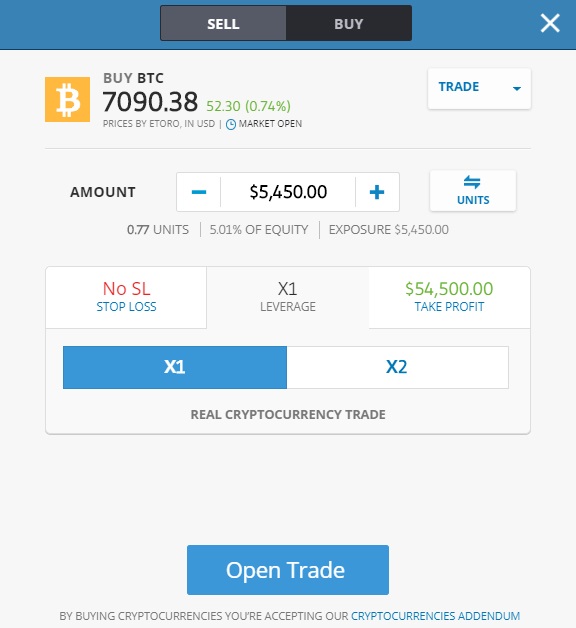
When operating in different markets you can use even more leverage. The reason is that cryptocurrencies are usually medium-long term investments, and leverage is used mostly for short-term operations or day trading. Let's talk a bit more about how leverage works:
- If you want to invest $ 1,000 and you use leverage x2, you will be starting with $ 2,000 ($ 1,000 are a “loan” from eToro).
- A few days later, Tether does rises, as you assumed, and now the price of your investment is $ 2,400 (20% more), so you decide to sell back.
- The $ 1k of leverage will be deducted, and you will have $ 1,400 left; which means you've earned $ 400, since the other $1,000 was yours initially.
By starting with $ 1000 and getting $ 400, you'll be earning 40% of your investment. That is pretty good.
But there's always a drawback. If all goes as you planned and the asset increases, you will make profits. However, if the price goes down, you will also lose more money really fast.
Supposing that the price didn't increase by 20%, but it decreased also by 20%, you won't lose $ 20 but $ 40, because of the leverage. That is why the terms “Take Profit” and “Stop Loss” are fundamental when using leverage.
Take Profit is used as a form of reducing risks when trading. When you enter, you can set a profit limit and ask that your position is automatically closed when the asset reaches a price.
If you purchased Tether at $ 100, you can ask eToro to close your operation when it reaches $ 120. That way, you make sure you won't change your mind and decide to keep waiting in case it keeps rising, which could make you lose it all.
Also, if you use leverage you absolutely need to place a Stop Loss order (take into account that any small loss is greater with leverage). Always remember to set a Stop Loss lower than that suggested by the broker.
About ETFs
What do you know about Exchange-traded funds or ETFs? They are similar to index funds and are known for combining the advantages of stocks and mutual funds: they can be traded at any moment in the market, but have much more investment possibilities and considerably lower fees.
About ETFs
What do you know about Exchange-traded funds or ETFs? They are passively managed funds, known for merging the benefits of stocks and mutual funds, because they can be exchanged at any moment in the market, but have much more variety and the rates are significantly lower.
Currency market
Forex or currency trading is the exchange between two currencies in order to gain money through the operation.
If you decide to trade euros and dollars, you speculate how many dollars it will take to buy a euro, with the expectation that the first currency (the euro) will raise its price compared to the second (the dollar), to make a profit by selling it. Assume you entered when the price of one euro is 1.10 USD and you exit when it reaches 1.15: that difference is yours once you make the operation.
You may be thinking that this form of trading requires investing considerable amounts, and you are not wrong, since increases in prices are never that dramatic, and often you will need to use high leverage (which sometimes can be too much of a risk). Our advice for those starting in the world of trading is to choose another market to begin with, since Forex is risky and complex.
eToro allows trading with the most common currency pairs but remember that Forex works with contract for differences, therefore the underlying asset won't be yours.
Commodities or raw materials
Most investors trade with raw materials because of their stability. While other assets present higher fluctuation, raw materials prices vary less and offer safety against inflation or market volatility. Nevertheless, prices are subject to supply and demand, so if an economic situation produces higher demand for a certain good, the price will also increase.
Take into account that raw materials don't pay dividends. Therefore, the only prospective income would come from a future sale of the asset.
There are two basic kinds of commodities: hard raw materials and soft raw materials. The former include precious metals (such as gold, silver, copper, and platinum), industrial metals (for instance, iron, nickel, or aluminum), and oil; and the latter are agricultural products as sugar, coffee, corn, soy.
About Contracts for Difference
If you have entered eToro previously, you probably realized that the initials CFD appear repeatedly. Before we explain this further, you should know that cryptocurrency trading on eToro is only CFD when you go short.
If you are considering day trading cryptocurrency or other practices, next we will also address terms such as leverage and “going short”.
eToro lets you bet both “in the black” and “in negative”. In a hypothetical case: you are sure that the Tether will go down, so perhaps it is obvious to think “if it is going to depreciate or go down in price, I'll just wait and go when it has gone down”. Nevertheless, if it really falls, it might mean extra money for you.
You can do that by “going short”. Here's how it works:
- You get from a loan 100 units of Tether, valued at a total of $ 5,000 (these are completely fictional figures)
- You sell them at their price on the market, $ 5,000
- As you guessed, it devaluates, and the unit of Tether now costs $ 30 instead of $ 50
- You purchase all 100 units once again, but at the current value, $ 3,000
- You give back the 100 units
- The rest is yours, so, you will have earned $ 2000
Keep in mind that it seems much more tricky than how eToro CFDs actually work: we can summarize this whole operation by saying that by trading in Tether you can also make money if you anticipate it will go down.
How does eToro work?
We already said that one of the best features of eToro is that the platform is very friendly and easy to use. It isn't necessary to read a lot or have previous knowledge to start trading.
You won't have any issues with the interface if you have used any other social network.
We will talk about the sign-up process and the different tabs you will find on the page.
You will have to provide some personal information when registering.
Additionally, you will see that they ask you some questions about your experience at investing.
But don't feel intimidated. They only intend to find out how much you know and which financial instruments to recommend for you.
Let's see what the different sections of the page are.
“Set Price Alerts” allows you to set alerts on the price of certain securities. You only need to click on the three points at the end of the line and you will be able to program a price alarm. This is very useful when you want to buy an asset which price is decreasing, but it seems to you that it will decrease even more.
The section “News Feed” allows users to interact and share their experiences and knowledge.
“Instruments”, “People” and “CopyPortfolios” are within “Discover”. As we mentioned in this guide, the six types of instruments on eToro are:
- Cryptocurrencies
- ETFs
- Stocks
- Commodities
- Currencies
- Index funds
In “People”, you will find eToro users and their historical performance. This is where you can copy the strategies of your preferred traders.
In this section, you will be able to search for those users that you find more interesting. When you choose an investor and indicate the amount you want to invest, eToro will automatically replicate their movements, in proportion. For instance, if you invest $ 1000 and the user puts 20% of their funds in an asset, the platform will put $ 200 of your funds in the same asset or company as well.
You will also see the CopyPortfolios divided into three main kinds: “Top Trader”, “Market” and “Partner”.
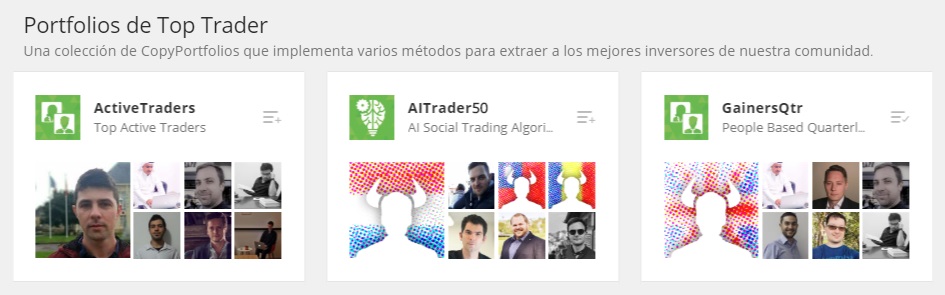
The advantage of copying to CopyPortfolios instead of individuals is that this way you will diversify the risk. There are all kinds of portfolios that you can find easily and are classified by sectors. Thus, if you think a specific sector, like fashion or drones, will prosper in the future, you can look for that specific portfolio and invest.
Virtual portfolio: How does it work?
Are you taking your first steps as an investor? Using a demo account can be useful. Just make sure the virtual mode is set in the upper left corner of the page and you can start trading with fictional funds.
This can be a great way of gaining experience and confidence before starting to trade with real money. You will have an amount of $ 100.000 (“fake” or virtual, of course) to begin with, and you can operate with all the different assets available on eToro, not only with Tether.
Don't worry, since if you lose all your virtual balance, you can contact support so they can add back the $ 100k to your portfolio and you can try again.
Keep in mind that you should always be cold-minded when investing, and perhaps a practice account can prevent you from controlling your impulses. It will never be the same as risking your own money.
As you may suppose, if you want to invest in the medium or long-term, with profits almost assured only by duplicating an index, it doesn't make sense that you waste years investing with a demo account. On the contrary, the virtual mode can be helpful to practice with short or medium-term operations.