
Contents
eToro, our reccomended broker for acquiring Litecoin from Nigeria
Why do we recommend it?
- Really intuitive and straightforward
- Allows to replicate investment tactics
- Accepts “shorting” or short-selling
- Leverage is allowed
- Allows you to invest in tons of other products
Official page: www.etoro.com/litecoin
In case you are considering it, eToro is probably the best way to obtain Litecoin from Nigeria.
“Social trading”, an innovative investment method that consists in replicating techniques and strategies from other experienced investors, has become popular thanks to eToro.
If you are a beginner or haven't gained much experience in investments, eToro is great for you, because it automatizes your investment by repeating strategies from experienced traders with a very long profit history. Also, in case you do have experience in investment, the platform pays you for sharing it.
Another thing to mention is how intuitive the interface is, which turns out perfect for new users that are just learning all about Litecoin.
eToro Interface
We mentioned before that eToro is very friendly and intuitive. Anyone can start investing without previous experience or long explanations.
If you are familiar with any of the most popular social networks today, you can perfectly manage eToro's interface.
Let's talk about how to register and the different sections of eToro.
You will have to fill in some requested data when registering.
They will also ask you about your previous investment activities.
But don't feel intimidated. They only intend to find out how much you know and which assets to recommend for you.
You will see a bar that says “incomplete profile” until you complete all the requested information.
Let's get to know the fundamental sections of the interface.
With the “Set Price Alerts” tool, you'll be able to program an alarm when a security is at a certain price. This is helpful if you want to purchase a security and you are waiting for its price to fall.
The section “News Feed” allows users to interact and learn from each other by sharing their opinion and experiences.
In “Discover” you will find the investment tabs: “Instruments”, “People” and “CopyPortfolios”. And we discussed previously in this guide the different financial instruments on eToro:
- Cryptocurrencies
- Exchange-Traded Funds
- Stocks
- Raw materials
- Forex trading
- Index funds
In the tab “People”, you can find eToro users and their performances. This is where the term “social trading” makes sense since you can copy with just one click the movements of your preferred traders.
You can search and find users according to your interests. You can search by risk level, trading market, profits or country, among other filters. When you choose an investor and indicate the amount you want to invest, eToro will automatically replicate their movements, in proportion. If you have $ 1000 and the user puts 20% of their funds in an asset, eToro will put $ 200 of your funds in the same asset as well.
You will also see the three main types of CopyPortfolios, which are classified into “Top Trader”, “Market” and “Partner”.

The advantage of copying to CopyPortfolios instead of individuals is that this way the risk will be more diversified. The different portfolios are easily identifiable: one about gaming, another about large drone companies, another about pharmacy … You think that a certain industry will prosper in the future? Then look, because surely there is a CopyPortfolio about it.
Have you heard about “leverage”? We'll put it simply:
trading lets you invest more money than you can have in a given time. That is, if you get in with $ 100 and you choose to leverage x2, the amount of your investment will be $ 200.
Leverage and the importance of “Take Profit” and “Stop Loss”
Let's assume that you know that Litecoin is going to appreciate, therefore you decide “going long”.
You are completely sure that Litecoin will rise, and you have $ 1,000 at that moment, but the fact is, you have the chance of investing more.
There's the possibility of asking for a loan, but you must know that all the process takes time, and by the moment you finally get the money, Litecoin might be already at a much higher price, so you wouldn't be able to invest the way you planned.
Leverage is like a credit, and you will only have to click a few times! You will be able to invest (and earn) much more money than what you have on the platform's wallet. It is simple, before investing you will see the different options as in the image below:
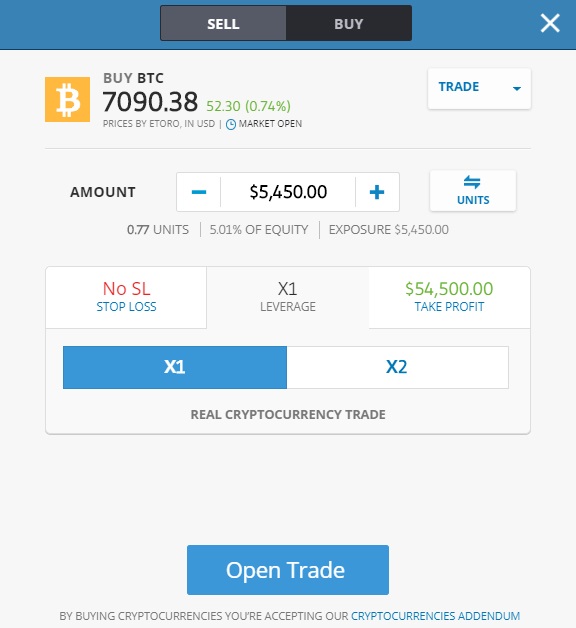
Within other markets, you can use more leverage. Why? Because cryptocurrencies usually represent medium-long term investments, and leverage is used mainly for day trading or short-selling. Let's talk a bit more about how leverage works.
If you have the $ 1,000 and use leverage x2, your investment is 2 * $ 1,000, that is to say, $ 2,000. eToro would be “loaning” you the extra $ 1,000.
A week later turns out that Litecoin rises up and now the value of your investment is 20% higher, which means, you have $ 2,400 in Litecoin. So, a wise decision is to sell them back now.
You will have to give back the $ 1,000 of leverage and you will have made $ 400 (since the other $ 1,000 was your initial investment).
In conclusion, by investing $ 1000 you can make a profit of 40% (in the case you earn $ 400). That is quite good.
But there's always a downside. If everything goes ok and the asset increases, you will make money. However, if the asset decreases, you will also lose more money really fast.
For instance: if the price falls by 10%, you won't lose $ 10, but twice (the leverage) that figure, that would be $ 20. Because of that, the terms “Take Profit” and “Stop Loss” are fundamental when using leverage.
Take Profit is a trading limit you can set for your assets: you program your operation and ask the platform to sell them once they get to a point above the entry price. For instance, you can buy Litecoin at $ 100 and request that your position is closed automatically when it reaches $ 120. It is very helpful to avoid being blinded by enthusiasm: we would all take a 20% profit when investing, but when you reach that 20% it is easy to want higher profits and put yourself at risk of losing money. It's like you got assured in advance that you will act prudently.
Stop Loss is even more important, particularly if you use leverage, since a small loss with leverage can be fatal for your wallet. For that reason, it is essential to mark a Stop Loss lower than that suggested by the broker.
How to deposit funds on eToro
When it comes to payment on eToro, there is not much to say, since it is pretty simple. Just click “Deposit funds”, put an amount, and choose the payment option you prefer. You can pay with PayPal, bank transfer, credit card (Visa, MasterCard, Diners, Visa Electron and Maestro), Skrill, or Neteller.
(Keep in mind that you must be the account or credit card holder, for security reasons).
The minimum you can deposit is $ 200 and there is a limit of how much you can deposit if you are not verified. Therefore, in case you plan to operate with higher amounts, contact Support previously to verify your account.
The platform accepts transfers in any currency, but charges a fee for making the conversion to USD. That is why we recommend, if possible, depositing in USD from the beginning.
What's the difference between CFDs and futures?
Here are the most important differences between CFDs and Futures, in case you want to know more:
- Counterparties
- Futures: operations are made with someone else, another investor.
- CFDs: you do not operate with another individual, but the counterparty is the brokerage platform.
- Expiry date:
- Futures: they expire. At that point, your operation is ended even if you are in losses.
- CFDs: on the contrary, there is no expiration date. This means that you can wait until you get in a good position before closing.
- Options for trading:
- Futures: there are fewer options for investment
- CFDs: they include lots of different assets, commodities and currencies
- Minimum investment amount:
- Futures: you need to get in with a larger amount
- CFDs: you can start with a small deposit
- Trading costs and charges:
- Futures: as you need to pay more in the first place, fees are lower
- CFDs: rates are higher
- Possibility of using leverage:
- Futures: there is no leverage leverage
- CFDs: it is always possible to leverage
How do Contracts for Difference Function?
You probably have found the acronym CFD now and then if you entered eToro before. Before we explain what this is, you should know that CFDs on eToro are only possible if you short sell or use leverage above x2 (and this is not even an option on eToro).
In case you want to try at some point day trading cryptocurrency or other advanced practices, next you will also find information about concepts like leverage and “going short”.
eToro allows you not only to bet when you are “in the black”, but with CFDs you can also bet “in negative”. Let's say that you believe that the Litecoin will go down, so the logical thing is to think “if it is going to depreciate or go down, I simply wait and I'll go in when it has gone down”. But if you really think that it's going down, why not take advantage of that?
The operation known as “going short” will allow you to do that. It works, roughly, this way:
- You ask for a loan of, let's say, 100 units of Litecoin, which total price at that moment is $ 5,000 (these figures aren't real)
- You make $ 5,000 by selling the 100 units
- The Litecoin devaluates from $ 50 to $ 30
- You get the 100 units again, but at $ 3,000
- You give back the 100 units to the loaner
- There: the $ 2000 difference is yours
Take into account that it is much easier than it sounds: we can summarize this whole operation by saying that by trading in Litecoin you can also earn money if you predict it will go down.
Investment strategies
When trading cryptocurrencies, there are different possible methods or strategies, like day trading or buying and holding, for naming just a couple.
My recommendation for those who are beginning to trade is going for a middle point: placing a dynamic stop-loss (15-20% under the highest price) and wait for it to work its magic.
Therefore, if for example you buy a cryptocurrency at $ 10, it reaches $ 20, and after that it falls to $ 12, your stop loss will close your position at $ 16-17 and you will obtain a pretty good profit.
I know it might sound more appealing to sell when the cost is at its peak, right before corrections, but that is simply not possible. The mentioned method is much more down-to-earth and, well applied, it can work very well.
And when you have gained more experience, you can take your first steps with advanced investment techniques, like short-selling or using leverage.