
Contents
eToro is an outstanding broker for those in Australia who want to acquire NEO
Advantages:
- User-friendly and simple
- You are able to learn from other investment strategies
- Accepts “shorting” or short-selling
- eToro allows leverage
- Lets you make investments in countless of other products
Official homepage: www.etoro.com/neo
If you are considering buying NEO from Australia, eToro may be the best way to do it.
This broker is popular for making “social trading” fashionable. Social trading is a revolutionary form of investing in which traders can repeat the strategies of other investors who have been generating income over time.
eToro is very helpful if you don't have much experience in trading. You can rest assured that you are making a smart investment since the site emulates those from subjects with a great deal of expertise. Oppositely, if you are an investor willing to share your knowledge with the community, eToro rewards you with money.
Besides, this platform is completely manageable, ideal for those who want to begin in the NEO world, without ending up overwhelmed with tons of numbers and information.
eToro Interface
We mentioned previously that eToro is very friendly and intuitive. Anyone can start investing without having to read endless explanations.
Everyone who has previously used social networks like Instagram or Facebook, has enough knowledge to operate with the eToro interface.
We will explain the registration process and the different sections that you will see.
You will have to provide some personal information (like full name or address, for instance) when registering.
Also, you will see that they ask you some questions about your experience as an investor.
But don't feel intimidated, it is not a test that you have to pass. The only intention is to know more about you and be clear about which financial instruments they should suggest according to your knowledge and experience.
You will see a bar that says “incomplete profile” until you complete all the requested information.
Let's review the different functions of the interface.
With the “Set Price Alerts” tool, you'll be able to program an alarm when a security is at a certain price. This is helpful if you want to purchase an asset that is falling but you believe it will decrease more to a certain point.
“News Feed” is the more “social” section. There, users can interact and share experiences.
“Instruments”, “People” and “CopyPortfolios” are within “Discover”. And we already discussed the kinds of assets that are available on eToro:
- Cryptocurrencies
- ETFs
- Stocks
- Raw materials
- Currencies
- Index funds
In “People” are all the profiles and historical performances of other investors, and you can replicate their strategies with just one click. This is where the “social trading” term is best applied.
You will be able to find those users that you find more interesting. When you select an investor and indicate how much money you want to invest, eToro will automatically replicate their movements, proportionally. If you have $ 1000 and the trader puts 20% of their funds in an asset, eToro will also invest 20% of your money in the same company or instrument, in this case, $ 200.
You will also find the CopyPortfolios divided into three main kinds: “Top Trader”, “Market” and “Partner”.
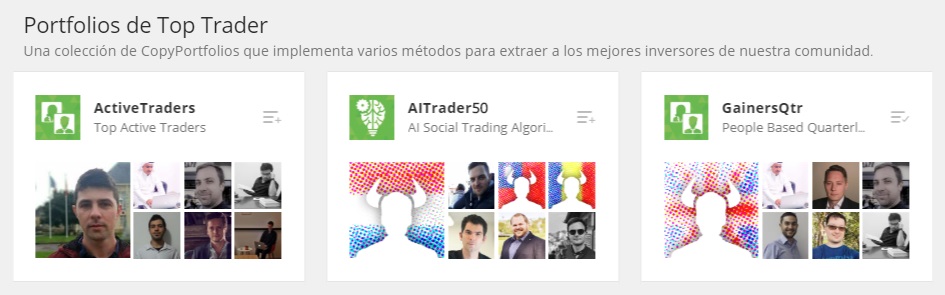
The advantage of using CopyPortfolios instead of copying specific traders is that this way the risk will be more diversified. There are all kinds of portfolios that you can recognize easily and are divided by sectors. Therefore, if you think a specific industry, like gaming or drones, will have good incomes in the future, you can look for that specific portfolio and do your investment.
Can you rely on eToro?
eToro has been tested by independent organizations several times to certify its fidelity in displaying performance statistics from previous users. And it has been confirmed every time that eToro is rigorous with the figures.
The main headquarters of eToro is located in Cyprus, and the platform is approved by the Cyprus Securities Market Commission (or CySEC), which can cover up to € 20,000 from its client's debts, including those from Australia. On the other hand, eToro meets all the strict requirements of the European Union.
It is also backed by the European Financial Instruments Market or MiFID, and in the USA it is under the control of the Financial Conduct Authority (FCA). In addition to all these regulations, eToro has worked for fifteen years and that it has more than 20 million users around the world, so we can rest assured that our funds are in good hands.
No less important is their excellent customer service. They have a phone number for assistance, a ticket system to track any claim, and a live chat.
By the way, do you know what leverage is? Just in case, we'll define it shortly:
the good thing about trading is that it allows you to invest even more than what you really have. Let's say that you enter with $ 100 and you choose to leverage x2, the amount of your investment will be $ 200.
Leverage and the importance of “Take Profit” and “Stop Loss”
Let's say now that you are sure that NEO is going to rise, thus you decide “going long”.
You are absolutely certain that NEO will go up, but you can only invest $ 1,000. Isn't it a shame to miss out on the possibility of earning more money?
You could consider requesting a loan, but you must know that all the process takes time, and when you receive the money, NEO might be already so expensive (if your guess was right) that investing wouldn't be convenient anymore.
Leverage is just like a credit, but it is only a few clicks away! eToro allows you to operate with much more than what you have on the platform's wallet. Before trading, you will find the leverage options as in the screenshot below:
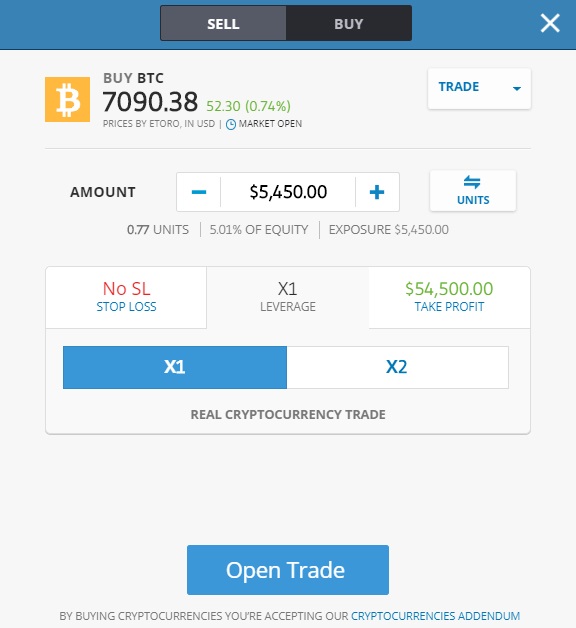
Within other markets, the ability to leverage is greater. This is because cryptocurrencies are usually medium-long term investments. However, leverage is used mostly for short-term operations or day trading. Let's talk a bit more about how leverage works:
- If you decide to invest $ 1,000 and you use leverage x2, you will be starting with $ 2,000 (remember that$ 1,000 was “borrowed” from eToro).
- A few days later, NEO does rises, as you thought, and now the cost of your investment is $ 2,400 (20% more), so you decide to sell back because you want to play it safe.
- Once the $ 1k from leverage is deducted, you will have $ 1,400 left; which means you've earned $ 400, since the other $1,000 was yours initially.
In conclusion, by investing $ 1000 and obtaining $ 400, your net profit would be 40%. That is pretty decent.
But watch out: if all goes as you planned and the asset increases, you will make profits. Nevertheless, if the asset decreases, you will also lose more money really fast.
For instance: if the price falls by 10%, you won't lose $ 10, but twice (the leverage) that figure, that would be $ 20. For that reason, when operating with leverage it is very important to be familiar with other two terms: Take Profit and Stop Loss.
Take Profit is a limit you can set when trading: you set the platform to sell your assets once they get to a point above the entry price. For instance, you can buy NEO at $ 100 and request that your position is closed automatically when it goes up to $ 120. It is very helpful to avoid being blinded by greed: a 20% profit is usually pretty good, but once you see it goes up, you might want to gain a bit more and decide to wait, but this could be a mistake. So, Take Profit helps you reduce risks when trading.
Also, if you use leverage you absolutely need to place a Stop Loss order (take into account that any small loss is greater with leverage). You always need to set a Stop Loss lower than that suggested by eToro.
eToro deposit methods
When it comes to depositing funds on eToro, there isn't really much to say, since it is pretty simple. You just have to click “Deposit funds”, type an amount, and choose your payment method. You can pay with PayPal (available for some countries), bank transfer, credit card, Skrill, or Neteller.
Consider that for security policies, you need to be the owner of the credit card or the account.
You can start with a $ 200 deposit, and there is a limited maximum for unverified accounts. Thus, if your intention is to deposit higher amounts, you should contact Support to verify your account.
You can pay in any currency you want and eToro will do the conversion to USD. However, it is better to use USD anyway since the platform charges a fee for the conversion.
ETFs
Exchange-Traded Funds or ETFs are similar to index funds. They can be described as a combination of stocks and mutual funds, including the best of both. They can be traded like regular stocks, but include a wide diversity of assets and have lower fees.
Foreign exchange market
Foreign exchange trading or Forex consists, as the name says, in the exchange of currencies. Put differently, is the conversion of one currency to another, and the aim is, evidently, to obtain a benefit out of this.
If you decide to trade euros and dollars, you acquire euros at their price in dollars, with the expectation that the euro will increase compared to the dollar. Then, if you purchased each euro at 1.15 USD and you sell them back when their price is 1.20 USD, you'll be keeping that difference.
Perhaps you already deducted this, but this type of trading usually implies large resources, because prices never increase that much, or using much leverage, which is a bit like skating on thin ice, as you know. If you are new to the world of trading, it is not a good idea to begin with this market, because it is very risky and complex.
You can operate with almost every popular currency on eToro. However, bear in mind that in Forex trading sales are always made through contract for differences, thus the underlying asset won't be yours.
Stocks
Now let's discuss the most well-known financial assets: stocks or shares. Stocks are portions in which an enterprise can be divided. You can own a proportion of a company and obtain a profit, but first, you should know where and how to invest your money.
We could say that there are two main types of shares: those that pay dividends and those that do not. Those that pay, at the end of the fiscal year, distribute profits among the stockholders; the latter, on the other hand, do not. Does that mean that you should only consider the former? No, of course not: if a company does not pay every year but has a lot of potential, it is also worth investing in it, since the capital gain you will get from the sale of the shares can be much greater than what you would earn through dividends.
If you invest in stocks that pay out dividends, you will receive them into your account on eToro. Therefore, you can collect that money or you can choose to reinvest it. However, compound interest is magic, so our suggestion is that you reinvest in the company if you don't need the money immediately.
Take into account that when investing in shares on eToro you can use leverage to “dope” your trades, but in that case, you will not receive interest as the trade is a contract for difference. For that reason, for long-term investments, it is better not to use leverage: not only because you lose dividends, but you will also have to pay commissions while you keep the position open, and these can end up with your gains.
Exchange-Traded Funds
ETFs or Exchange-Traded Funds are similar to index funds. They can be described as a combination of stocks and mutual funds. They can be traded like regular stocks, but include a wide diversity of assets and their fees are much lower than those of an actively managed fund.
About Index Funds
This is the best option for people who can invest in the long term, especially for those who are starting to trade, because it is inexpensive, diversified, and safer.
Unlike a lot of people think, beating the benchmark is far from being a piece of cake and very few fund managers achieve that, apart from some famous cases.
In practice, if a fund manager achieves to beat the benchmark, it is only for a short time or on a specific occasion. Or perhaps they would charge very high rates and indexing would be a better decision.
Index funds offer these two great benefits: although in the long term, they regularly beat active managers, and the commissions are so much lower.
Raw materials
The major benefit of investing in commodities is that prices are more stable than those of other financial products. In fact, their stability is what makes most investors trade with raw materials when facing possible inflation or market volatility. Still, the prices of commodities are defined by their demand. Therefore, if a given economic situation provokes higher demand, the prices will also rise.
Note that commodities don't pay dividends. Thus, the only potential further earnings would come from a sale of the asset.
There are two main kinds of commodities: hard raw materials and soft raw materials. The former are precious metals (such as gold, silver, copper, and platinum), industrial metals (like aluminum, iron, or zinc), and oil; while the latter are agricultural products as cocoa, soybeans, rice, or sugar.
Investment strategies
When trading cryptocurrencies, there are different possible methods or strategies, such as day trading or buying and holding, for naming just a couple.
In case you are a beginner in the world of trading, I recommend something in the middle: placing a dynamic stop-loss (15-20% under the highest price) when you open your NEO operation and wait for it to work.
Therefore, if for example you buy a cryptocurrency at $ 10, it reaches $ 20 and then falls to $ 12, your position will be closed at $ 16-17 and you will have made a considerable profit.
It might sound more appealing to sell when the price is at its highest, right before corrections, but unless you're psychic, that will never be possible. The mentioned method is much more realistic and, well applied, it can work very well.
Later on, you will be able to apply more sophisticated strategies, such as using leverage or going short to make money from bear markets.