
Contents
eToro, our reccomended platform for buying Litecoin in India
Why do we recommend it?
- Really intuitive and simple
- It takes other successful investment strategies so you can copy them
- Allows you to go short
- eToro allows leverage
- There are lots of possibilities for investments
Main site: www.etoro.com/litecoin
In case you are thinking about obtaining Litecoin from India, eToro may be the best way to do it.
This platform is popular for making “social trading” a trend. Social trading is an ingenious form of investing in which users can replicate the movements of other traders who have been generating income for a long time.
If you are still a rookie or haven't gained much investment experience, eToro is great for you, because it puts your investment on automatic by imitating moves from those who have been doing it for years and making profits. On the contrary, if you are an expert in the field and decide to share your abilities with others, eToro pays up for it.
Besides, the platform is so uncomplicated, great for those who want to start in the Litecoin universe, without stressing over tons of graphs and figures.
Is eToro trustworthy for purchasing Litecoin?
eToro is very careful with the data about past performances from users, and its integrity has been independently tested several times.
eToro follows all the strict policies of the European Union, legislation in which it is found. Specifically, its main headquarters is in Cyprus, and it is approved by the CySEC or Cyprus Securities Market Commission, which can cover up to € 20,000 of the debts that its clients may have with creditors, including those from India.
eToro responds to the European Financial Instruments Market (MiFID), and to the Financial Conduct Authority (FCA) in the U.S. You should also know that it has a trajectory of fifteen years, with more than 20 million users around the globe. So, yes, it is a safe broker.
No less important is their excellent customer service. You can reach them by phone or use their live chat.
Futures Vs CFD
What are the differences between Futures and CFDs?
- Counterparties
- Futures: operations are made with someone else, another investor.
- CFDs: you don't “play” against someone else, the counterparty is the broker.
- Expiration date:
- Futures: there is an expiration date. Once the contract expires, it is closed and can't be reopened.
- CFDs: they don't expire. You can wait until you get in a good position before exiting.
- Trading options:
- Futures: it is more restricted
- CFDs: they include lots of different assets, commodities and currencies
- Minimum investment amount or “trade size”:
- Futures: minimum investment is higher
- CFDs: you can get in with a small initial deposit
- Costs and commissions:
- Futures: as you have to invest more, fees are lower
- CFDs: higher (although they are not excessively high either)
- Leverage:
- Futures: it isn't possible to trade with leverage
- CFDs: completely available
Exchange-Traded Funds
ETFs or Exchange-Traded Funds are a kind of passively managed fund, similar to index funds. We can say that ETFs are halfway between stocks and funds: they are publicly traded, that means they can be exchanged at any moment at market price. However, their main benefit is that they offer more alternatives compared to stocks, and have lower fees.
About ETFs
ETFs or Exchange-Traded Funds are similar to index funds. We can say that ETFs are somewhere between stocks and funds: they can be traded like regular stocks, but include a wide diversity of assets and have lower fees.
About Index Funds
Are most adequate for those planning to invest for the long term, mostly for beginners. If you don't need to use the amount of money you'll invest in less than five or ten years, index funds are a safe option.
Unlike a lot of people think, benchmark returns are very difficult to beat and very few fund managers have done it, apart from some famous cases, like Warren Buffett's.
If a fund manager brags about having beaten the index, they probably did it for a short time or on a specific occasion, or sometimes the commissions are so high that indexing would be a better decision anyway (with minimal commissions).
With index funds, you won't be concerned about that: although in the long term, they frequently beat active managers, and the fees are minimal.
Raw materials
Most people invest in raw materials due to their stability. While other assets tend to fluctuate more, raw materials prices vary less and offer safety against inflation or market volatility. Nevertheless, prices are subject to supply and demand in the market, so if the fear of possible inflation provokes higher demand for a certain good, the price will also rise.
Take into account that, unlike shares, raw materials don't pay dividends. Thus, the only prospective earnings would come from a sale of the asset.
Raw materials are usually categorized into hard raw materials, which include precious metals, industrial metals, and oil; and soft raw materials, which are basically agricultural products, like soy, cocoa, corn, or rice, for instance.
Currency market
Currency trading or Forex consists, as the name says, in the exchange of currencies. In other words, is the conversion of one currency to another to make a profit through the operation.
For example, if you decide to trade euros and dollars, you acquire euros at their price in dollars, anticipating that the first currency (the euro) will increase compared to the second (the dollar), to make a profit by selling it. Suppose you entered when a euro is worth 1.10 USD and you leave when the price has gone up to 1.15: that difference is yours once you make the operation.
You may be thinking that operating with currencies requires investing considerable amounts, and that is correct, because fluctuations are usually minimal, and often you will need to use high leverage (which is an important risk). In case you are just starting in trading, it is not a good idea to begin with this market, because it is very risky and intricate.
eToro allows exchanging the most known currency pairs. Nevertheless, consider that Forex works through CFDs, so you won't own the real asset.
How do Contracts for Difference Function?
If you already browsed eToro, you probably realized that the initials CFD appear frequently. We will come back to it, but first, you should know that cryptocurrency trading on eToro is only CFD when you go short.
In case you want to know about day trading cryptocurrency and other more advanced operations, we will also cover terms such as leverage and “going short”.
The good thing about eToro is that it allows you to bet both “in the black” and “in negative”. Let's say that you believe that the Litecoin will fall, so perhaps you consider that the best thing to do is wait until it does and then go in. However, if it actually goes down, you can make some profits out of that.
You can accomplish that by “going short”. More or less, this is how it works:
- You ask for a loan of, let's say, 100 units of Litecoin, which total value at the moment is $ 5,000 (these numbers aren't real)
- You sell the 100 units at $ 5,000
- The price is reduced, as you calculated, and the unit of Litecoin now costs $ 30 instead of $ 50
- You purchase the 100 units again, but their total current value is now $ 3,000
- Then you return the 100 units
- The $ 2000 difference is yours
Take into account that it is much easier than it sounds: we can just say that by trading in Litecoin you can also earn money if you predict the downs.
eToro Interface
We mentioned before that eToro is very easy to manage. Anyone can start using it without having to read endless explanations.
If you are familiar with any of the most popular social networks today, you can perfectly manage eToro's interface.
Now we are going to walk you through the registration process and the different sections of the page that you should familiarize yourself with.
When you open your account, you will have to fill in all the information that eToro asks for: first and last name, address…
To complete your profile, you will have to answer some questions about your experience at investing.
But don't worry: it is not an exam. They only intend to know how much knowledge you have and what type of financial instruments they can recommend. For example, if it is your first experience in the investment world, they will not suggest that you invest in futures.
You will see a bar that says “incomplete profile” until you complete all the requested information.
Let's see what the different sections of the platform are.
With the “Set Price Alerts” tool, you'll be able to program an alert when an asset is at a certain price. This is perfect if you want to buy an asset and you are waiting for it to decrease.
“News Feed” is for social purposes and interaction. This is the section where users can share opinions and information.
“Instruments”, “People” and “CopyPortfolios” are within “Discover”. And we already talked about the different financial instruments on eToro:
- Cryptocurrencies
- Exchange-Traded Funds
- Stocks
- Commodities
- Currencies
- Index funds
In the section “People”, you will find the public profiles of eToro users and their performances. This is where “social trading” makes sense since you can duplicate with just one click the movements of the traders that inspire you the most.
You will be able to search and find users according to your interests. You can search by risk level, trading market, profits or country, among other filters. When you choose an investor and indicate how much you want to invest, eToro will automatically replicate their movements, in proportion. If you have $ 1000 and the trader puts 20% of their funds in an asset, the platform will put $ 200 of your balance in the same asset or company as well.
Finally, you will also find the CopyPortfolios divided into three main kinds: “Top Trader”, “Market” and “Partner”.
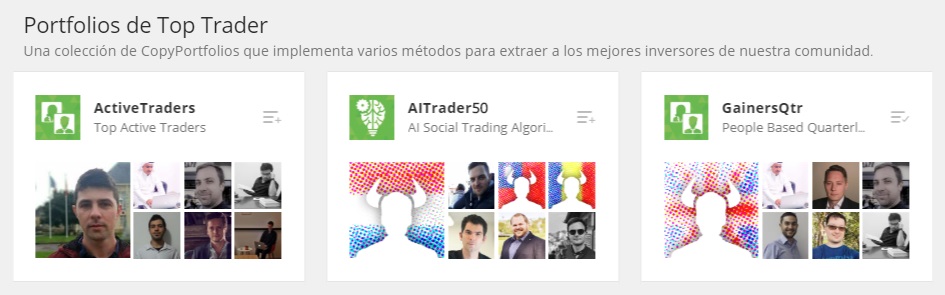
Sometimes you might prefer copying to CopyPortfolios than to particular users, because the former offer more diversity. There are all kinds of portfolios that you can recognize easily and are divided by sectors. Therefore, if you think a specific sector, like fashion or drones, will prosper in the future, you should probably look for that specific portfolio.
Trading strategies
There are lots of cryptotrading trategies: from buying and waiting to day trading using price fluctuations in your favor.
My recommendation for those who are starting to invest is going for a middle point: when you open your position, place a stop-loss 15-20% below the top price, and let the magic happen.
This means that if, for example, you acquire a cryptocurrency at $ 10, it goes up to $ 20 and then decreases to $ 12, your stop loss will close your position at $ 16-17 and you will have earned a decent profit.
You may be wondering: why not selling when the price is at its peak? But unless you are a psychic, that is just impossible. The mentioned strategy can work perfectly and is much more realistic.
And when you have gained more experience, you will be ready for more advanced trading strategies, such as using leverage or going short.
Practice account
For those who still don't have much experience in investing, using a demo account can be useful. You just need to set the virtual mode and you can start trading with “fake” funds.
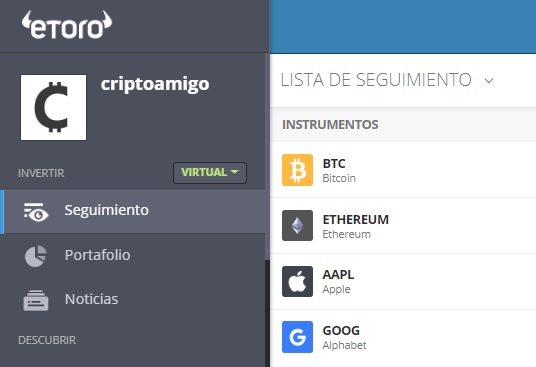
A virtual account can be a good way of gaining confidence before starting to operate with real money. When you create your demo account, you will begin with a virtual amount of $ 100.000, to operate with a variety of assets available on the platform, besides Litecoin.
If your performance is not that good and you lose your funds, there is always a possibility to replenish your virtual funds. The second time will always be better.
Nevertheless, remember that you need to be prudent for trading, and using a demo account can have an adverse effect. It is not the same to risk your own money than to trade with a false balance that you don't mind losing. Besides, using fake money can prevent you from learning to control your emotions, something you should be able to do when trading.
As you may suppose, the virtual mode is kind of pointless if you want to invest in the medium or long-term (which almost assures you a profit only by replicating an index), since you would be wasting years to see the outcome. Virtual accounts may be helpful for practicing before investing in the short or medium-term.