
Contents
eToro is an outstanding broking platform for buying Ethereum Classic from Kenya
Pros:
- You can make investments in thousands of different goods
- Leverage is allowed
- User-friendly and simple
- It takes other successful investment strategies so you can emulate them
- Allows you to go short
Official site: www.etoro.com/ethereum-classic
If you are considering obtaining Ethereum Classic from Kenya, eToro may be the best option today.
“Social trading”, a relatively new form of investing by replicating techniques and strategies from other experienced investors, has become popular thanks to eToro.
eToro has solutions for you, especially if you are still a novice user in trading. You can rest assured that you are making a smart investment since the site duplicates those from subjects with a long profit record. On the other hand, if you are an expert in the subject and want to share your techniques with the community, eToro rewards you with money.
Another advantage is how intuitive the interface is, which turns out perfect for new users that are learning all about the trading world.
About Contracts for Difference
It is possible that you have seen the term CFD all the time if you already registered on eToro. We will come back to it, but first, you should know that CFDs on eToro are only possible when you go short or use leverage higher than x2 (nevertheless, the platform does not even allow this option).
We will also refer to terms such as short-selling and leverage, in case you are interested in day trading cryptocurrency or more advanced practices.
With CFDs you can bet on the platform even if you are “in red” or don't have a positive balance. In a hypothetical case: you believe that the Ethereum Classic will fall, so the logical thing is to think “if it is going to depreciate (go down in price), I'll just wait and bet when it has gone down”. But if you are sure that it is going down, why not take advantage of that and making money?
The operation known as “going short” will allow you to do that. It functions, roughly, like this:
- You obtain from a loan 100 units of Ethereum Classic, which cost $ 5,000 (these are completely made up numbers)
- Next, you earn $ 5,000 by selling them at the market price
- The Ethereum Classic devaluates from $ 50 to $ 30
- Again, you purchase the 100 units, but at the current price, $ 3,000
- You pay back the 100 units
- You will have made $ 2000, since you keep the difference
Take into account that it is much simpler than it sounds: we can summarize this whole operation by saying that by trading in Ethereum Classic you can also earn money if you anticipate it will go down.
What's the difference between CFDs and futures?
What are the main differences between Futures and CFDs?
- Counterparty
- Futures: the exchange is made with another trader.
- CFDs: the operations are not made with someone else, the counterparty is the broker, in this case, eToro.
- Date of expiry:
- Futures: they have an expiry date. Once the contract expires, it is closed and can't be reopened.
- CFDs: on the contrary, there is no expiration date. You can wait for your position to rise before closing.
- Variety:
- Futures: options are much more restricted
- CFDs: a lot of variety, there are CFDs of practically anything
- Minimum deposit:
- Futures: you need to start with a larger amount
- CFDs: you can get in with a small deposit
- Costs and fees:
- Futures: costs are usually lower
- CFDs: rates are higher
- Leverage:
- Futures: you can't leverage
- CFDs: it is always possible to leverage
BTW, do you know what leverage is? Just in case, we'll define it briefly:
the good thing about trading is that it allows you to invest more money than you can have in a given time. That is, if you get in with $ 100 and you choose to leverage x2, the amount of your investment will be $ 200.
Leverage and the importance of “Take Profit” and “Stop Loss”
Let's say now that you are sure that the price of Ethereum Classic is going to raise its price, therefore you decide “going long”.
You are completely certain that Ethereum Classic will rise, and you just have $ 1,000 at that moment, but the fact is, you have the chance of investing more.
Possibly, you could ask your bank for a credit, wait for it to be accepted and receiving the money, and then acquire Ethereum Classic… But maybe once you have made all that, your prediction could've been confirmed a long time ago, and Ethereum Classic would be already so high that it is not worth investing.
Leverage is exactly like a credit, but it is only a few clicks away! eToro allows you to operate with much more money than what you have on the platform's wallet. Before trading, you will how much leverage to use as in the screenshot below:
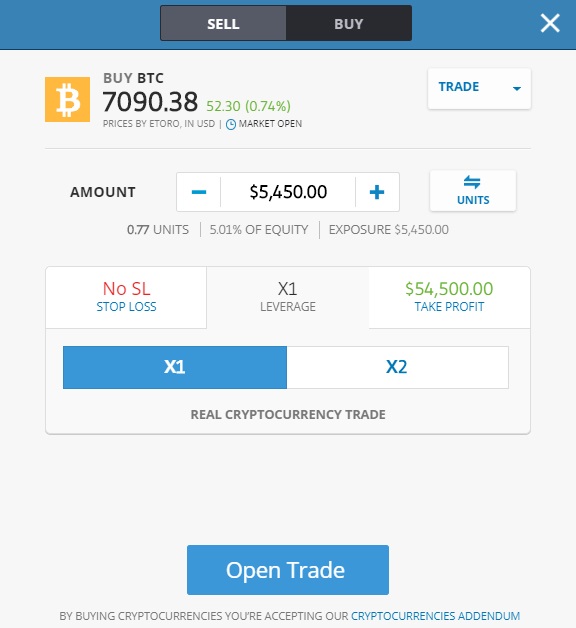
When trading in different markets you can use even more leverage. Why? Because leverage is most common in short-term operations or day trading, and cryptocurrencies tend to be a medium or long-term investment. But let's see how this works with the previous example.
If you have the $ 1,000 and choose leverage x2, you will be investing $ 2,000, as we mentioned. eToro would be “loaning” you the extra $ 1,000.
A week later Ethereum Classic goes up and now the value of your investment is 20% higher, which means, you have $ 2,400 in Ethereum Classic. But you don't want to be too greedy, so you decide, wisely, to sell back.
You will have to pay back the $ 1,000 of leverage and the net profit would be $ 400 (since the other $ 1,000 was your initial investment).
In conclusion, by investing $ 1000 you can make a profit of 40% (in the case you earn $ 400). That is pretty decent.
But there's always a drawback. If all goes as you planned and the price rises, you will make money. However, if the price goes down, you will also lose more money in the blink of an eye.
For instance: if instead of increasing by 20%, the price falls by 10%, you won't lose $ 10, but twice that figure, which means $ 20, because of the leverage. That is why to operate with leverage it is essential to take into account Take Profit and Stop Loss.
Take Profit is the automatic order to sell once the asset is above the entry price: you purchase Ethereum Classic at $ 100 and you ask eToro to automatically close your operation as soon as the price reaches $ 120. It is very helpful to avoid being blinded by enthusiasm: a 20% profit is usually very good, but once you see the price has risen, you might want to gain a bit more and decide to wait, but this could be a mistake. So, Take Profit helps you reduce risks when trading.
Stop Loss is even more important, particularly when trading with leverage, since a small loss could have a significant impact. Always remember to establish a Stop Loss lower than that suggested by the platform.
About ETFs
What do you know about Exchange-traded funds? They are passively managed funds, known for merging the benefits of stocks and mutual funds, because they can be exchanged regularly at market price, but include a much wider diversity of assets and the fees are significantly lower.
Exchange-Traded Funds
Exchange-Traded Funds or ETFs are similar to index funds. They can be described as a merge between stocks and mutual funds, including the best of both. They can be traded like regular stocks, but include a wide diversity of assets and the rates are much lower than those of an actively managed fund.
About Index Funds
If a long-term investment sounds like something you would do, and you won't need to withdraw your money in at least five years, index funds can be the best choice. This kind of investment is also suitable for beginners since the risks are much lower. Besides, they offer more diversity.
Contrary to common perception, very few fund managers can beat their benchmark return (yes, you have probably heard of investors who obtain huge profits).
But except for Warren Buffett and a couple more, not everything is as good as it sounds: when someone brags about having beaten the benchmark, they have probably done so for a short period, or the rates are so high that it ends up being better for you to index (whit minimal commissions). Besides, past performances do not ensure a future one.
With index funds, you won't be concerned about that: although in the long term, they regularly beat active managers, and the fees are lower than you imagine.
Raw materials
Most investors trade with raw materials because of their stability. While other assets present higher fluctuation, raw materials prices vary less and offer safety against inflation or market volatility. Nevertheless, prices do depend on supply and demand in the market, so if the fear of possible inflation produces higher demand for a certain good, the price will also rise.
Note that the only intended profit from the investment in raw materials will be the hypothetical capital gain after the sale since, unlike stocks, these don't distribute dividends or pay interest.
Raw materials are commonly categorized into hard raw materials, which include precious metals as gold, silver, or copper, as well as industrial metals, and oil; and soft raw materials, which are basically agricultural goods, like soy, cocoa, corn, or rice.
Investment strategies
When trading cryptocurrencies, there are different possible methods or strategies, such as buying and holding or day trading (and using price fluctuation in your favor), for naming just a couple.
My recommendation for those who are starting to trade is going for a middle point: placing a dynamic stop-loss (15-20% under the highest price) and wait for it to work.
For instance, if you buy a cryptocurrency at $ 15, then it increases to $ 25 and decreases again to $17, the stop-loss will close your position at $ 21 or $ 22. Thus, you will obtain a good profit.
I know it's tempting to look to sell when the cost is at its maximum, right before corrections, but that is simply not possible. The above strategy is much more realistic and it can give great results.
And when you have gained more experience, you will be ready for more advanced trading strategies, like going short or using leverage.
eToro deposit methods
When it comes to depositing funds on eToro, there is not much to say, since it is pretty simple. You just have to click “Deposit funds”, set an amount, and choose your payment method. You can use PayPal (available for some countries), bank transfer, credit card (Visa, MasterCard, Diners, Visa Electron and Maestro), Skrill, or Neteller.
(Consider that you must be the account or credit card owner, for security policies).
The minimum amount you can deposit is $ 200 and there is a limited amount if you are not verified, so if you plan to operate with higher amounts, you should verify your account previously.
You can pay in any currency and eToro will do the conversion to USD. However, we suggest depositing directly in USD since the platform charges a commission for the conversion.
Can you rely on eToro?
eToro has been tested by independent organizations once and again to verify its integrity in displaying performance statistics from previous users. The results have always confirmed that eToro is meticulous with the figures.
Legally, eToro fulfills all the strict regulations required by the European Union. Specifically, its head office is in Cyprus, and it is validated by the Cyprus Securities Market Commission (known as CySEC), which can cover up to € 20,000 of the debts that its clients may have with creditors (those from Kenya included).
It is also backed by the European Financial Instruments Market or MiFID, and in the USA it responds to the Financial Conduct Authority (FCA). In addition to all these regulations, it should be mentioned that eToro has worked for fifteen years and that it has more than 20 million users, so we can be sure that our money is in good hands.
Finally, their customer service functions perfectly. You can reach them by phone or use their live chat.
Virtual account
In case you are beginning as an investor, the possibility to operate in “demo” mode may be useful. You only need to set the “virtual” option and your operations will be carried out with “imaginary” funds.
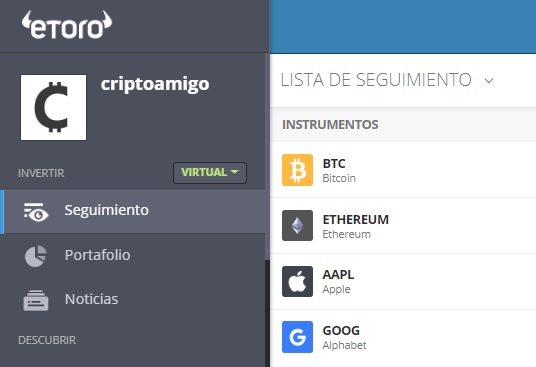
A virtual portfolio can help you to practice and gain experience before starting to trade with real funds. When you create your demo account, you will begin with a virtual amount of $ 100.000, to operate with a variety of assets available on the platform (not only with Ethereum Classic).
Don't worry, since if you lose all your virtual funds, you can contact support so they can add back the $ 100k to your demo account and you can make a second attempt.
Take into account that you should always be cautious when trading, and perhaps a demo account can make you a bit impulsive. It is not the same to trade with your own money than with fake funds, which you can lose without a problem.
As you may suppose, the virtual mode is kind of absurd if you intend to trade in the medium or long-term, since you would be wasting years. Demo accounts may be helpful for trying out short or medium-term investments.
eToro Interface
We said before that eToro is very friendly and intuitive. Anyone can start investing without having to read endless explanations.
You won't have any issues with the interface if you are familiar with any other social network, like Twitter or Facebook.
We will explain the registration steps and the different tabs that you will see on eToro.
You will have to fill in some information requested when registering.
Also, you will have to answer some questions about your experience at investing.
However, it is not like you are answering a test. It is only a way of finding out how much knowledge you have and what type of financial instruments they can suggest. For instance, if it is your first experience in the investment world, they will not suggest that you invest in futures.
Let's get to know the different sections of the page.
With the “Set Price Alerts” tool, you'll be able to program an alert when an asset is at a certain price. Just click the tab and you will be able to set it. This is ideal in case you want to buy a security that is falling but you believe it will decrease even more.
In the “News Feed” tab is the most social part of eToro: where users are interacting all day and sharing opinions, tips, and other valuable information.
“Instruments”, “People” and “CopyPortfolios” are within “Discover”. And we discussed previously in this guide the different financial instruments on eToro:
- Cryptocurrencies
- ETFs
- Stocks
- Raw materials
- Currencies
- Index funds
In “People” are all the profiles and historical performances of other investors, and you can replicate their strategies with just one click. This is where the “social trading” term is best applied.
You can search for those investors that you find more interesting: by average earnings, types of instruments or risk level, for instance. You just have to choose the amount you want to invest and eToro will replicate the movements of the investor you selected, in proportion. This means that if you have $ 1000 and the trader puts 10% of his or her balance in an asset, eToro will invest also 10% of your funds (in this case $ 100) in that same asset.
Also, here you will see CopyPortfolios classified into three categories, Top Trader, Market, and Partner.

The benefit of copying to CopyPortfolios instead of individuals is that this way you will diversify the risk. The different portfolios are easily identifiable: one about gaming, another about large drone companies, another about pharmacy … Do you suspect that a certain sector will prosper anytime soon? Then look, because surely there is a CopyPortfolio about it.