
Contents
eToro is an excellent broker for those who are in New Zealand and want to obtain EOS
Why do we recommend it?
- Very user-friendly and straightforward
- You can imitate other investment tactics
- You can go short
- eToro allows leverage
- It is possible to invest in thousands of different products
Homepage: www.etoro.com/eos
In case you are thinking about obtaining EOS from New Zealand, eToro is probably the best way to do it.
“Social trading”, an innovative investment method that consists in replicating techniques and moves from other experienced investors, has become popular thanks to eToro.
eToro is very useful if you don't have much experience in trading, because it puts your investment on automatic by emulating moves from experienced traders with a very long profit history. On the other hand, if you are an expert in the subject and want to share your abilities with other traders, eToro pays you for it.
Another thing to mention is how easy the platform is, which turns out perfect for new users that are learning all about the trading world.
eToro payment methods
When it comes to payment on eToro, there is not much to say, since it is really straightforward. Just click “Deposit funds”, type an amount, and choose your payment method. You can use PayPal (available for some countries), bank transfer, credit card (Visa, MasterCard, Diners, Visa Electron and Maestro), Skrill, or Neteller.
Remember that for security reasons, you must be the owner of the credit card or the account.
You can start with a $ 200 deposit, and there is a limited maximum for unverified accounts. Thus, if you intend to trade with much more, you will need to verify your account previously.
eToro accepts transfers in any currency, but you will have to pay a fee for the conversion to USD. So it is better to use USD from the beginning.
How are CFDs and futures different?
How are CFDs and Futures different?
- Counterparty
- Futures: operations are made with someone else, another investor.
- CFDs: the counterparty is the broker (eToro).
- Date of expiration:
- Futures: there is an expiration date. Once the contract expires, it is closed and can't be reopened.
- CFDs: there is no expiration date. It is possible to wait until you rise up and then close.
- Options for trading:
- Futures: there are limited options
- CFDs: they include lots of different assets, commodities and currencies
- Minimum investment amount or “trade size”:
- Futures: you have to invest much more
- CFDs: you can start with a lower minimum trade size
- Costs and rates:
- Futures: as you need to pay more in the first place, costs are lower
- CFDs: costs are higher
- Use of leverage:
- Futures: nonexistent leverage
- CFDs: fully available
Do you know the term “leverage”? Just in case, we'll put it simply:
the good thing about trading is that it allows you to invest more money than what you really have. That is, if you get in with $ 100 and you choose to leverage x2, you will be actually investing $ 200.
Leverage and the importance of “Take Profit” and “Stop Loss”
Suppose now that you know that the price of EOS is about to raise its price, and you choose to take a long position.
You are completely certain that EOS will rise, and you just have $ 1,000 at that moment, but the fact is, you have the chance of investing more.
There's the possibility of requesting a loan, but you must know that all the process takes time, and when you receive the money, EOS might be already at a much higher price, so you wouldn't be able to invest the way you planned.
Thanks to leverage, you can obtain that amount with two clicks. It's like a loan, but much easier and quicker, and with the benefit that you will be getting it directly from eToro which will let you invest much more than you have on the platform. You will simply see the different options as in the image below:
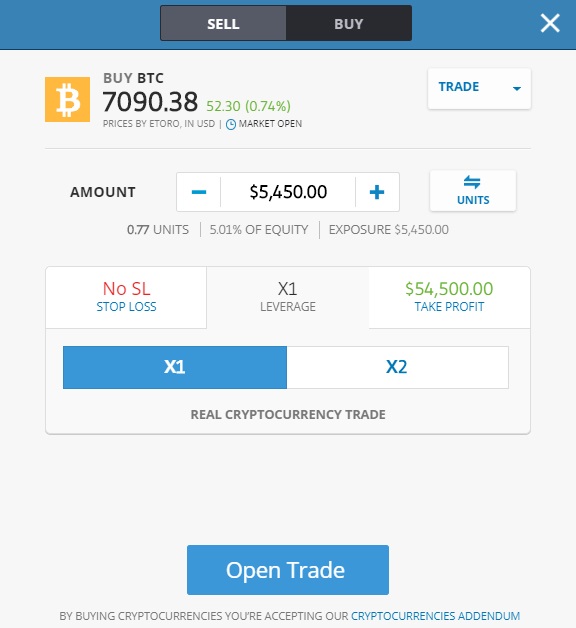
When operating with other kinds of assets you can use more leverage. Why? Because leverage is most common in short-term operations, and cryptocurrencies tend to be a medium or long-term investment. But let's see how leverage works with the previous example:
- If you want to invest $ 1,000 and you use leverage x2, you will be starting with $ 2,000 ($ 1,000 was borrowed from eToro).
- A few days later, EOS does increases, as you thought, and now the price of your investment is $ 2,400 (20% higher), so you decide to sell back because you want to play it safe.
- The $ 1k of leverage will be deducted, and you will have $ 1,400 left; which means you've earned $ 400, since the other $1,000 was yours initially.
In conclusion, by investing $ 1000 and obtaining $ 400, your net profit would be 40%. That is quite good.
But there's always a drawback. If all goes as you planned and the asset increases, you will make profits. However, if the price falls, you will also lose more money really fast.
Let's imagine that the asset didn't increase by 20%, but it went down also by 20%, you won't lose $ 20 but $ 40, because of the leverage. For that reason, the concepts of Take Profit and Stop Loss are crucial when using leverage.
Take Profit is the automatic sell order that is above the entry price: you purchase EOS at $ 100 and you ask eToro to automatically close your operation as soon as the price goes up to $ 120. It is very helpful to avoid being blinded by enthusiasm: a 20% profit is usually very good, but once you see the price has risen, you might want to gain a bit more and decide to wait, but this could be a mistake. So, Take Profit helps you to trade more safely.
On the other hand, when trading with leverage you also have to use Stop Loss, because a small decrease in the price of an asset can lead to a substantial loss. Always remember to set a Stop Loss lower than that suggested by the broker.
How to use eToro
We said previously that eToro is very friendly and intuitive. Anyone can start investing without previous knowledge or long explanations.
If you are familiar with any of the most popular social networks today, you can perfectly manage eToro's interface.
Now we will walk you through the registration process and the sections of the page that you should familiarize yourself with.
You will have to fill in some information requested when registering.
Additionally, you will have to answer some questions about your experience as an investor.
But don't feel intimidated. They only intend to find out how much you know and which instruments to recommend for you.
You will see a bar that says “incomplete profile” until you fill in all the information.
Let's get to know the fundamental sections of the platform.
With the “Set Price Alerts” tool, you'll be able to program an alarm when an asset is at a certain price. This is ideal if you want to buy a security and you are waiting for its price to fall.
The section “News Feed” allows users to interact and share their experiences and knowledge.
In “Discover” you will find the tabs: “Instruments”, “People” and “CopyPortfolios”. As we mentioned in this guide, the six types of instruments on eToro are:
- Cryptocurrencies
- Exchange-Traded Funds
- Stocks
- Raw materials
- Forex trading
- Index funds
The concept “social trading” makes sense within “People”: there, you can copy the movements of any user you choose. You'll be able to see all their profiles and historical performances.
You can search for those users that you find more interesting: by average profits, types of assets or risk level, for example. You just have to type the amount you want to invest and eToro will be in charge of replicating the movements of the selected investor, in proportion. “In proportion” means that if you put $ 1000 and the investor puts 10% of their capital in Amazon, eToro will also invest $ 100 of your money in the same company.
Also, here you will see CopyPortfolios classified into three categories, Top Trader, Market, and Partner.
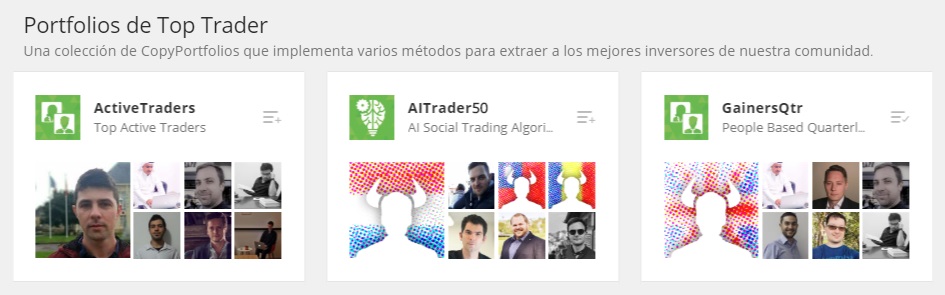
The advantage of using CopyPortfolios instead of copying individual investors is that this way the risk will be more diversified. The different portfolios are easily identifiable: one about gaming, another about large drone companies, another about pharmacy … Do you suspect that a certain industry will prosper in the future? Then you will surely find a CopyPortfolio about it.
Trading strategies
There are many ways to operate cryptocurrencies: for example, you can buy and hold, or you can day trade (taking advantage of market volatility).
My suggestion for those who are beginning to trade is something in the middle: when you open your EOS position, place a dynamic stop loss 15-20% below the maximum price, and let the magic happen.
Therefore, if for example you purchase a cryptocurrency at $ 10, it goes up to $ 20 and then decreases to $ 12, your stop loss will close your position at $ 16-17 and you will have made a decent profit.
Perhaps you are wondering: why not selling when the cost is at its maximum? But that would only work for a psychic or a fortune-teller. The mentioned strategy is completely realistic and can work out perfectly if it is well applied.
Later on, you will be able to apply more sophisticated techniques, such as going short or using leverage.
How does a virtual account work?
If you are beginning as an investor, you can start by practicing with a “demo” option. Setting a virtual account and trading with fictional money is very simple.
This can be a great way of gaining experience and confidence before starting to trade with real funds. The platform will give you an amount of $ 100.000 (“fake” or virtual, of course) to begin with, and you will be able to operate with all the different instruments available on eToro, not just with EOS.
The first attempt is not usually that good. But you can ask support to replenish the virtual $ 100k to your portfolio, and the second try you should do better.
But remember that investing is mainly about being cautious, and using a demo account can have the reverse effect. It is completely different to risk your real savings than to operate with virtual funds that you don't mind losing.
Finally, if you are going to invest in the medium or long-term, with profits almost guaranteed only by replicating an index, it doesn't make sense that you waste years investing with a virtual account. On the other hand, short and medium-term investments are perfect to try out with the demo mode.