
Contents
eToro is an outstanding broker for those in Philippines who want to purchase Ethereum Classic
Why do we recommend it?
- It takes techniques and moves from successful investors so you can copy them
- Accepts short-trading
- It's simple and manageable
- eToro offers leverage
- It is possible to invest in tons of different goods
Official page: www.etoro.com/ethereum-classic
eToro is probably the best way to purchase Ethereum Classic from Philippines.
This platform is well-known for making “social trading” fashionable, a revolutionary way of investing in which traders can emulate the moves of other investors who have been making earnings for years.
If you are a novice user or do not have much experience in investments, eToro is very useful. You can rest assured that you will be doing a smart investment move when replicating those from subjects with a great deal of expertise. And for those skilled investors willing to share their techniques with the community, eToro rewards your knowledge with money.
It is also worth mentioning how easy is to manage the platform, perfect for beginners who are taking their first steps in the investment world.
Is eToro reliable for purchasing Ethereum Classic?
eToro is very rigorous with the information about past performances from users, and its integrity has been independently tested several times.
Legally, eToro follows all the demanding policies of the European Union, legislation in which it is found. Its main offices are in Cyprus, where it is certified by the CySEC or Cyprus Securities Market Commission, which can cover up to € 20,000 of the debts from its clients (those from Philippines included).
eToro is backed by the European Financial Instruments Market (MiFID), and by the Financial Conduct Authority or FCA in the United States of America. You should also know that it has a trajectory of fifteen years, with more than 20 million users around the world. So, you can be sure that your money is safe.
It is also worth mentioning the great customer service. You can use the online chat, and they also have a phone number available for assistance.
Futures Vs CFD
How are Futures and CFDs different?
- Who is the counterparty? With Futures, the counterparty is another investor. In CDFs, it’s the broker (eToro)
- Expiration date Futures expire in a variable given date, while CFDs don’t expire
- Variety of options for trading Futures include fewer options to trade. CFDs include a wide range of possibilities.
- Minimum investment amount Costs for Futures are higher than costs for CFDs.
- Is it possible to leverage? With Futures, you can’t leverage; while with CFDs leverage is always available.
In case you still don't know what “leverage” is, we'll describe it briefly. When trading, it's the capacity of increasing your investment by borrowing money from the broker. That way, if you start with $ 100 and you use x2 leverage, you will be investing $ 200.
About leverage, Take Profit and Stop Loss
Let's say now that you know that Ethereum Classic is going to rise, therefore you are thinking about “going long”.
You are certain that Ethereum Classic will go up, and you have $ 1,000 at that moment, but the fact is, you have the chance of investing more.
Possibly, you could ask a financial company for a credit, put something as collateral, wait for it to be accepted and receiving the money, send the money to eToro, confirm that it arrived, and then purchase Ethereum Classic… However, once you've managed doing all that, probably Ethereum Classic would be already at a much higher price, and investing wouldn't be a good idea anymore.
Using leverage, you can get that amount just by moving a finger. It's just like a loan, but much better: from eToro itself. You can get financing to invest much more money than you actually have on the eToro Wallet. As in the image below, you will see the different options you have:
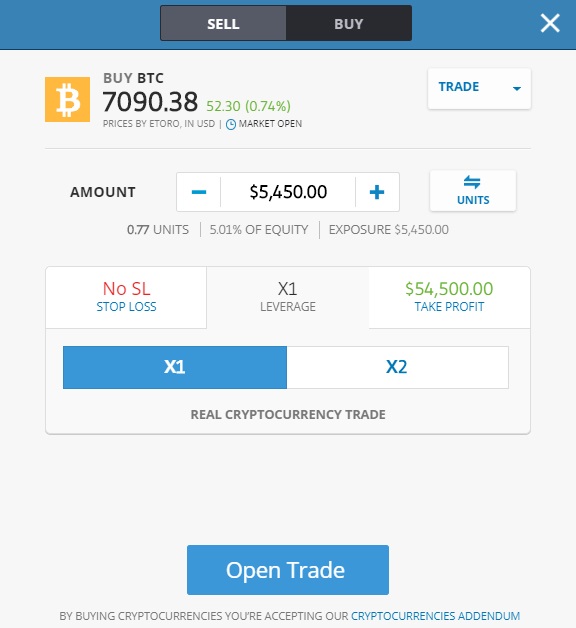
With other assets, you can use more leverage. Why? Because cryptocurrencies are a value that is invested in the medium-long term, and leverage is used primarily for short-term operations or day trading. But let's see how this works with the previous example:
- If you decide to invest $ 1,000 and you use leverage x2, you will be starting with $ 2,000 (remember that$ 1,000 are a “loan” from eToro).
- Then, turns out that Ethereum Classic does increases, as you thought, and now the cost of your investment is $ 2,400 (20% more), so you decide to sell back because you want to play it safe.
- The $ 1k of leverage will be deducted, and you will have $ 1,400 left; which means you've earned $ 400, since the other $1,000 was yours from the beginning.
By starting with $ 1000 and getting $ 400, you'll be earning 40% of your investment.
Still wondering where the catch is? The thing is, you can also lose. If everything goes according to plan and the price goes up, you will make more money in less time; however, if the value of the asset goes in the opposite direction, you will also lose more in less time.
Let's imagine that the price didn't increase by 20%, but it decreased also by 20%, you won't lose $ 20 but $ 40, because of the leverage. That is why to operate with leverage it is crucial to know about Take Profit and Stop Loss.
Take Profit is the automatic order to sell once the asset is above the entry price: you purchase Ethereum Classic at $ 100 and you ask eToro to close your position as soon as the price goes up to $ 120. It is very helpful to avoid being blinded by greed: we would all take a 20% profit in the beginning, but when you reach that 20% it is easy to ask yourself “what if this keeps increasing and it is a mistake to exit?”. It's like you made sure now of not acting recklessly in the near future.
Stop Loss is even more important, particularly when trading with leverage, since a small loss could be fatal for your wallet. Consider that eToro will recommend a limit for Stop Loss, but you should set it lower than the platform suggests.
How does eToro work?
We already said that one of the best features of eToro is that the platform is very intuitive and easy to use. You don't need to read a lot or have previous knowledge to start trading.
You won't have any problems with the interface if you have used any of the most common social networks, like Linkedin or Twitter.
We will explain, roughly, the registration steps and the different tabs that you will find.
First of all, you will have to enter all the information that eToro asks for: first and last name, address…
Also, you will see that they ask you some questions about your experience as an investor.
But don't feel intimidated, there is no right or wrong answer. They only intend to find out about your previous experience and knowledge to determine which assets to recommend for you.
You will see a bar that says “incomplete profile” until you fill in all the information.
Let's see what the different sections of the platform are.
In the “Set Price Alerts” tab, you have, as its name says, the option to set alarms on the price of certain securities. It is a very useful tool for when you are after a security which price is decreasing, but it seems to you that it has not finished falling yet.
The section “News Feed” allows users to interact and learn from each other by sharing their opinion and experiences.
“Discover” includes the tabs “Instruments”, “People” and “CopyPortfolios”. As we discussed in this guide, the six types of instruments on eToro are:
- Cryptocurrencies
- Exchange-Traded Funds
- Shares
- Commodities
- Currencies
- Index funds
In “People” are all the profiles and historical performances of other users, and you can replicate their movements with just one click. This is where the “social trading” concept is best applied.
You can search for those users that you find more interesting. You can apply filters like risk level, average profits, or financial market. When you choose an investor and indicate the amount you want to invest, eToro will automatically replicate their movements, proportionally. If you have $ 1000 and the trader puts 20% of their funds in an asset, eToro will also invest 20% of your money in the same asset, in this case, $ 200.
You will also see the CopyPortfolios divided into three main categories: “Top Trader”, “Market” and “Partner”.
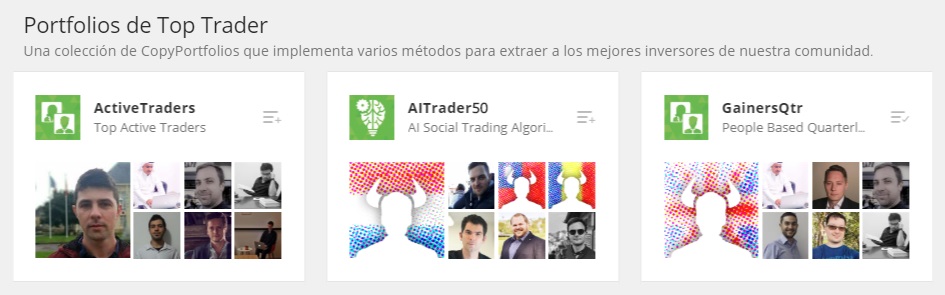
Sometimes you might prefer copying to CopyPortfolios than to particular traders, since you avoid putting all your eggs in one basket, or in other words, risk is more diversified. Besides, the different portfolios are easily identifiable: one about gaming, another about large drone companies, another about pharmacy … Do you suspect that a certain sector is going to have success in the future? Then you will surely find a CopyPortfolio about it.
Investment strategies
When trading cryptocurrencies, there are different possible methods or strategies, such as buying and holding or day trading (and using price volatility in your favor), for naming just a few.
My recommendation for those who are beginning to trade is something in the middle: when you open your Ethereum Classic position, set a dynamic stop loss 15-20% below the top price, and let the magic happen.
For example, if you purchase a cryptocurrency when its price is $ 15, then it increases to $ 25 and decreases back to $17, the stop-loss will allow your operation to be closed, perhaps at $ 21 or $ 22. Hence, you will get a pretty good income.
Perhaps you are wondering: why not selling back when the cost is at its peak? But unless you are a psychic, that is just not possible. The mentioned strategy can work perfectly and give good results.
Later on, you will be able to apply more complex strategies, such as going short to profit from bear markets or using leverage.
How does a demo account work?
For those who still don't have much experience in investing, using a demo account can be very helpful. You just need to set the virtual mode and you can start operating with fictional funds.
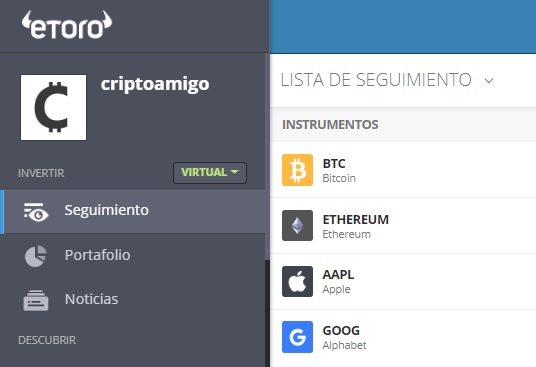
A virtual portfolio can help you to practice and gain experience before starting to operate with real money. When you open your demo account, you will begin with a virtual amount of $ 100.000, to operate with a variety of assets available on the platform, besides Ethereum Classic.
If your first attempts don't go well and you lose your funds, you can always ask eToro support to replenish $ 100k of virtual balance. Probably the second time will be much better.
Take into account that trading is mainly about being cautious, nevertheless, using a virtual portfolio might have the opposite effect. It will never be the same as risking your own money.
Evidently, the virtual mode is kind of absurd if you want to invest in the medium or long-term (with almost guaranteed returns only by replicating an index), since you would be wasting years to see the outcome. Demo accounts may be helpful for practicing before investing in the short or medium-term.