
Contents
eToro is an excellent broker for those who are in Philippines and want to purchase Ripple
Some of its advantages are:
- It's very easy to operate
- You are able to copy investment tactics
- Allows you to short sell
- Leverage is allowed
- You can make investments in tons of other goods
Official homepage: www.etoro.com/ripple
You should definitely consider eToro if you are thinking about acquiring Ripple from Philippines.
“Social trading”, an innovative investment method that consists in replicating techniques and strategies from other experienced investors, has become popular thanks to eToro.
eToro is very useful if you don't have much experience in trading. You can rest assured that you are making a smart investment since the site replicates those from subjects with a great deal of expertise. Also, in case you do have experience in investment, eToro pays you for sharing it with others.
Besides, the interface of the platform is so uncomplicated, great for a user who wants to begin in the Ripple world, without ending up overwhelmed with tons of numbers and information.
eToro Interface
As we have mentioned among the positive aspects of eToro, the best thing about this platform is its simplicity: anyone can use it without having to read endless explanations.
You won't have any issues with the interface if you are familiar with any other social network, like Twitter or Linkedin.
Let's talk about how to register and the different tabs you will find on the page.
When you open your account, you will have to fill in your personal data, like first name, last name, address….
Also, you will have to answer some questions about your experience as an investor.
But don't feel like you are taking an exam. The only intention is to know more about you and determine which financial instruments they should suggest according to your knowledge and experience.
You will see a bar that says “incomplete profile” until you fill in all the information.
Let's review the different functions of the page.
“Set Price Alerts” allows you to set alerts on the price of certain securities. You just have to click on the three points at the end of the line and you will be able to program a price alert. It is a very useful tool for when you want to buy an asset that is falling, but perhaps you think that it will decrease even more.
The section “News Feed” allows users to interact and learn from each other by sharing their opinion and experiences.
In “Discover” you will find: “Instruments”, “People” and “CopyPortfolios”. As we discussed in this guide, the six types of instruments on eToro are:
- Cryptocurrencies
- Exchange-Traded Funds
- Stocks
- Commodities
- Forex trading
- Index funds
The term “social trading” makes sense in the section “People”: that is where you can duplicate the strategies of any user you choose. You'll be able to see all their profiles and historical performances.
In this section, you will be able to search and find users according to your interests. When you choose an investor and indicate how much you want to invest, eToro will automatically replicate their movements, proportionally. For example, if you have $ 1000 and the trader puts 20% of their funds in an asset, eToro will also invest 20% of your money in the same asset, in this case, $ 200.
You will also see the three main types of CopyPortfolios, which are “Top Trader”, “Market” and “Partner”.
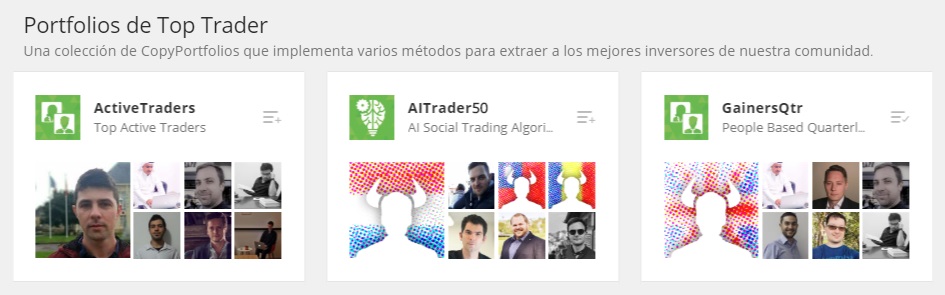
The benefit of copying to CopyPortfolios instead of individuals is that this way you will diversify the risk. There are all kinds of portfolios that you can identify easily and are divided by sectors. Thus, if you think a specific sector, like fashion or healthcare, has a good chance of prospering, you should probably look for that specific portfolio.
If you haven't heard about the term “leverage”, we'll put it short. When trading, it's the capacity of increasing your investment by borrowing money from the broker. For example, you can enter with $ 100, but if you use x2 leverage, you will be investing $ 200.
Leverage and the importance of “Take Profit” and “Stop Loss”
Assuming that, for instance, you are sure that Ripple is going up, and that you have $ 1,000 for “going long”, you should know that you have the option of investing more and making more money.
Possibly, you could ask a financial company for a credit, wait for it to be accepted, wait for the money, send the money to eToro, confirm that it arrived, and then acquire Ripple… But by then it is likely that your prediction was confirmed already and Ripple is so high that it is not worth investing.
With leverage, you can get that amount of money with two clicks. It's just like borrowing money, but much easier and quicker, and with the advantage that you will be getting it directly from eToro which will let you invest much more than you have on the wallet. You will simply see the different options as in the image below:
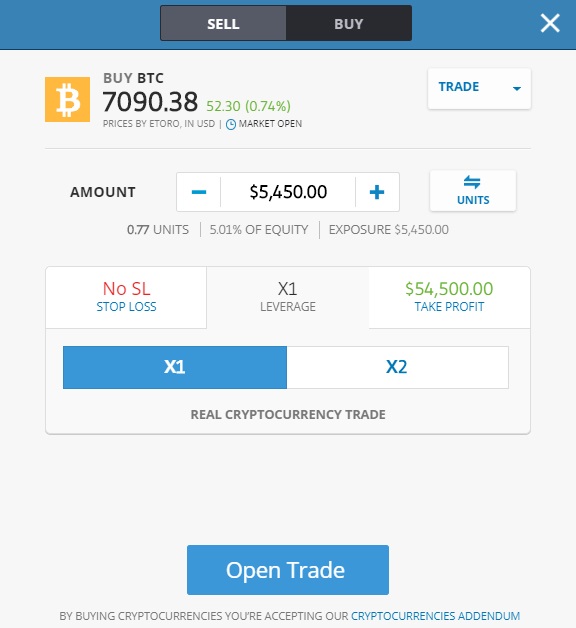
Within other markets, the leverage you can use is higher. Why? Because cryptocurrencies usually represent medium-long term investments. However, leverage is used mostly for day trading or short-term operations. But let's deepen a bit more on how all this works.
You enter with $ 1,000 and decide to use leverage x2, then you would have $ 2,000 to invest (the extra $ 1,000 to reach $ 2,000 are “borrowed” from eToro).
A few days pass and, indeed, you were right: Ripple has risen by 20% and the value of your investment is now $ 2,400. Ok, don't be greedy, it's time to sell.
You need to pay back the $ 1,000. You have $ 1,400 left, of which $ 1000 was yours initially, so the net profit is $ 400.
With $ 1000 you get $ 400, in other words, 40% more. That's not bad at all, right?
But watch out: if everything goes ok and the asset increases, you will make profits. However, if the price falls, you will also lose more money really fast.
Let's say that the asset didn't increase by 20%, but it decreased also by 20%, you won't lose $ 20 but $ 40, because of the leverage. Therefore, when trading with leverage it is fundamental to take into account Take Profit and Stop Loss.
Take Profit is used as a form of reducing risks when trading. When you enter, you can set a profit limit and ask that your position is automatically closed when the asset reaches a price.
If you bought Ripple at $ 100, you request eToro to close when it reaches $ 120. That way, you make sure you won't change your mind and decide to keep waiting in case it keeps going up, which could be a mistake.
Stop Loss is even more necessary, especially if you use leverage, since a small loss with leverage can be tragic for your wallet. Consider that eToro will recommend a limit for Stop Loss, but it is better to set it lower than the platform suggests.
How to deposit funds on eToro
Within the payment options available on eToro are: credit card, PayPal, bank transfer, Neteller, and Skrill. There is not much to explain here: making a deposit with eToro is really simple. You just need to go to “Deposit funds”, type a number and select your preferred method.
(Consider that you should be the account or credit card holder, for security reasons).
You can start from $ 200, and there is a limited maximum for unverified accounts. So, if you aim to operate with much more, you should contact Support to verify your account.
The platform allows deposits in any currency, but charges a commission for making the conversion to USD. That is why we suggest, if possible, using USD from the beginning.
About ETFs
Exchange-Traded Funds or ETFs are similar to index funds. We can say that ETFs are halfway between stocks and funds: they are traded in the market like stocks, during the day. But their advantage is that they are more diversified compared to stocks, and their commissions are much lower than those of an actively managed fund.
About Index Funds
This is the best option for people who can invest in the long term, mostly for those who are starting to trade, because it is inexpensive, diversified, and the risk is lower.
You may think differently, but beating the benchmark is far from being a piece of cake and very few fund managers achieve that, apart from some famous cases.
In practice, all that glitters is not gold: if a fund manager achieves to beat the benchmark, it is only for a short time or on a specific occasion. Or perhaps they would charge very high fees and indexing would be a better decision anyway (with minimal commissions).
Index funds offer solutions to both concerns: their rates are insignificant and in the long term they almost always beat active managers.
Commodities (raw materials)
The major attraction of investing in commodities is that prices are more stable than those of other assets. In fact, their stability is what makes most people trade with commodities when facing possible inflation or market volatility. Still, the cost of raw materials depends on supply and demand, so if faced with the fear of inflation, demand rises a lot, so will the price.
Consider that the only intended income from the investment in raw materials will be the hypothetical capital gain after the sale since, unlike stocks, these don't give returns or pay interest.
Commodities are commonly classified into two types: first, we have hard raw materials, which are precious metals (gold, silver, copper, and platinum), industrial metals, and oil; in second place are soft raw materials, which are agricultural goods such as coffee, rice, soy, or sugar.
Currency market
Forex or currency trading allows obtaining profits by exchanging one currency for another.
If you decide to trade EUR and USD, for instance, you speculate how many dollars it will take to buy a euro, with the expectation that after obtaining the first currency (the euro) it will increase compared to the second (the dollar), to make a profit by selling it. Assume you entered when a euro is worth 1.10 USD and you exit when it reaches 1.15: that difference is yours once you sell again.
You may be thinking that trading with currencies requires investing considerable amounts, and you're right, because fluctuations are usually minimal, and if you use a lot of leverage to counter that, you will take a considerable risk. In case you are new to the world of trading, we don't recommend beginning with the currency market, because it's not the safest option.
You can operate with the most common currency pairs on eToro. Still, remember that in Forex sales are made through CFDs, so you won't own the real asset.
Differences between futures and CFDs
How are CFDs and Futures different?
- Counterparty
- Futures: the counterparty is someone else, another trader.
- CFDs: the operations are not made with someone else, the counterparty is the broker, in this case, eToro.
- Date of expiry:
- Futures: there is a date of expiration. Once the contract expires, it is closed and can't be reopened.
- CFDs: on the contrary, there is no expiration date. As a result, you can wait until you get in a good position before exiting.
- Options for trading:
- Futures: there are fewer options for investment
- CFDs: you have plenty of options, there is a huge diversity of CFDs
- Minimum deposit amount or “trade size”:
- Futures: you have to invest much more
- CFDs: it is very low
- Trading costs and charges:
- Futures: being higher figures, the costs are, commonly, proportionally lower
- CFDs: costs are higher
- Use of leverage:
- Futures: you can't leverage
- CFDs: it is always possible to leverage
What are Contracts for Difference?
If you already registered on eToro, you probably realized that the initials CFD appear frequently. We will explain exactly what this means, but first, you should know that CFDs on eToro are only possible when you are short-selling or choose leverage above x2 (but this is not even available on eToro).
For your information, and in case you want to try at some point day trading cryptocurrency or other operations, below we will also refer to terms like going short and leverage.
eToro allows you not only to bet if you are “in the black”, but through CFDs you can also bet “in negative”. Let's say that you believe that the Ripple will fall, so probably you think that it is better to refrain from getting in until it actually falls. Nevertheless, if you are convinced that it is going down, why not making some profits?
You can do this through a practice known as “going short”. Its operation, roughly, works like this:
- You ask for a loan of, let's say, 100 units of Ripple, which cost $ 5,000 at the moment (obviously, these numbers aren't real)
- You sell the 100 units at $ 5,000
- The price falls, as you thought, and the unit of Ripple goes from $ 50 to $ 30
- You get the 100 units again, but at $ 3,000
- You pay back the 100 units
- There: the $ 2000 difference is yours
Consider that it seems much more tricky than it is: we can summarize this whole operation by saying that by trading in Ripple you can also make money if you foretell it will go down.
Investment strategies
When trading cryptocurrencies, there are different possible methods or strategies, like buying and holding or day trading (and using market fluctuation in your favor), for naming just a couple.
My recommendation for those who are starting to trade is something in the middle: placing a dynamic stop-loss (15-20% under the highest price) and wait for it to work on its own.
This means that if, for example, you buy a cryptocurrency at $ 10, it reaches $ 20, and after that it falls to $ 12, your stop loss will close your position at $ 16-17 and you will make a pretty good profit.
Perhaps you are wondering: why not selling back when the cost is at its peak? But unless you are a psychic, that is just impossible. The mentioned strategy can work perfectly and give good results.
And when you have gained more experience, you can take your first steps with advanced trading strategies, such as going short or using leverage.
Virtual portfolio
For those who still don't have much experience in investing, using a demo account can be very helpful. You just need to set the virtual mode and you can start trading with fictional funds.
This option is perfect for those who want to give it a few tries before trading with real funds. When you create your account, you will start with $ 100,000 of virtual balance to do all the operations that you can think of: not just with Ripple, you can also work with a diverse portfolio.
The first attempt is not usually that good. But don't worry, since you can ask support to replenish the virtual $ 100k to your portfolio.
Keep in mind that you should always be cautious when trading, nevertheless, using a demo account might have the opposite effect. It will never be the same as risking your own money.
As you may suppose, the virtual mode is kind of pointless if you want to invest in the medium or long-term (which almost assures you a profit only by replicating an index), since you would be wasting years. Virtual accounts may be useful for trying out before investing in the short or medium-term.