
Contents
eToro, recommended broker for those who want to purchase Ripple from USA
Why do we recommend it?
- It is uncomplicated and user-friendly
- Allows to replicate investment tactics
- Allows you to short sell
- eToro offers leverage
- There are lots of possibilities for investments
Homepage: www.etoro.com/ripple
You should certainly consider eToro in case you are interested in acquiring Ripple from USA.
“Social trading”, a relatively new investment method that consists in replicating techniques and strategies from other experienced investors, has become trendy because of eToro.
If you are still a newbie or do not have much experience in investments, eToro is great for you. You can rest assured that you will be making a smart investment since the site emulates those from subjects with a great deal of expertise. And for those skilled investors willing to share their techniques, eToro rewards your knowledge with money.
It is also very convenient how accessible is this platform, ideal for beginners who are taking their first steps with Ripple.
How to use eToro
As we have mentioned among the positive aspects of eToro, the best thing about this online broker is its simplicity: anyone can trade without having to read endless explanations.
If you have used any of the most common social networks, you can perfectly manage this platform.
Now we are going to walk you through the sign-up process and the different sections of the eToro interface that you should know.
You will have to provide some personal information (like full name or address, for instance) when registering.
During the sign-up process, you will also find some questions about your previous trade experience.
However, it is not like you are answering an exam. They only intend to know how much knowledge you have and what type of assets they can recommend. For example, if you have never invested before, they will not recommend that you invest in futures.
Let's review the different functions of the platform.
In the “Set Price Alerts” tab, you have, as its name indicates, the option to put alarms on the price of certain securities. You only need to click on the three points at the end of the line and you will be able to program a price alert. This is very helpful when you are after an asset that is falling, but perhaps you think that it has not finished falling yet.
The section “News Feed” allows users to interact and share their experiences and knowledge.
“Instruments”, “People” and “CopyPortfolios” are within “Discover”. And we discussed previously in this guide the kinds of assets that are available on eToro:
- Cryptocurrencies
- ETFs
- Stocks
- Commodities
- Forex trading
- Index funds
The concept “social trading” comes to life in the section “People”: that is where you can copy the movements of any investor you choose with just one click.
You can search and find users according to your interests. You can apply filters like risk level, average profits, or financial market. When you choose an investor and indicate the amount you want to invest, eToro will automatically replicate their movements, in proportion. If you invest $ 1000 and the user puts 20% of their funds in an asset, the platform will invest $ 200 of your funds in the same asset or company as well.
You will also find the CopyPortfolios divided into three main kinds: “Top Trader”, “Market” and “Partner”.
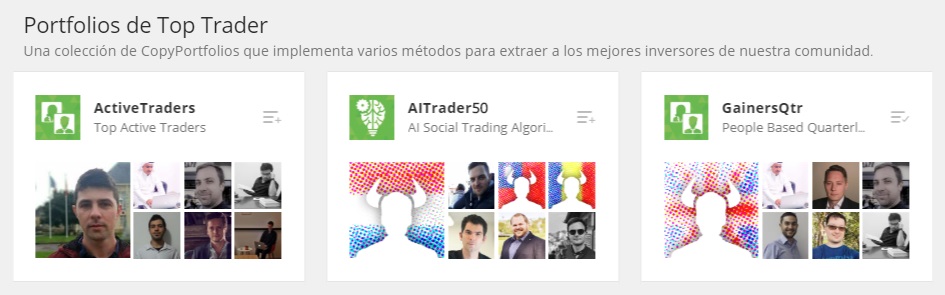
Remember that in some cases, it might be preferable to copy from CopyPortfolios than to individuals, because the former offer more diversity. There are all kinds of portfolios that you can find easily and are divided by sectors. So, if you think a specific sector, like gaming or drones, will have good incomes in the future, you can find that specific portfolio and invest in it.
Payment methods on eToro
When it comes to depositing money on eToro, there isn't really much to say, since it is pretty simple. You only need to select “Deposit funds”, type an amount, and choose the payment option you prefer. You can pay with PayPal (available for some countries), bank transfer, credit card, Skrill, or Neteller.
Evidently, for security reasons, you need to be the account or credit card holder.
The minimum you can deposit is $ 200 and there is a maximum limit of how much you can deposit if you are not verified, so if you want to trade with higher amounts, contact Support previously to verify your account.
Finally, know that you can make the transfer in any currency because eToro defaults all deposits to USD, although it charges a fee, so it is preferable to make the transfer directly in USD.
Exchange-Traded Funds
What do you know about Exchange-traded funds or ETFs? They are passively managed funds, known for combining the advantages of stocks and mutual funds: they can be exchanged regularly at market price, but offer much more variety and considerably lower rates.
Currency market
What is known as Forex trading consists in the exchange of currencies. In other words, is the conversion of one currency to another to make a profit through the operation.
In case you decide to exchange the EUR/USD pair, you speculate how many dollars it will take to buy a euro, expecting that the euro will rise compared to the dollar. Then, if you purchased each euro at 1.15 USD and you sell them back when their price is 1.20 USD, that margin will be yours.
You may be thinking that this form of trading requires high investments, and you are not wrong, since fluctuation in prices is never that dramatic, and if you use a lot of leverage to counter that, you will take a considerable risk. If you are a novice in trading, we don't recommend beginning with the currency market, because it's not the safest alternative.
You can trade with almost every currency on eToro but remember that in Forex sales are always made through CFDs, which means the underlying asset won't be yours.
Equities
The most common financial instruments are stocks: these are portions of publicly traded companies. It is possible to obtain a profit through third-party companies just by putting your money in them. But of course, you have to know where to put it.
Basically, there are two types of stocks: those that pay dividends and those that do not. Those that pay, at the end of the fiscal year, distribute earnings among their shareholders; the latter, on the other hand, do not. Does that mean that you should only consider the former? No, of course not: if a company does not pay out dividends but has a lot of potential, it can still represent a good inversion, since selling the shares in the future could pay a lot more.
When trading on eToro, if you choose a company that distributes dividends, these will be reflected in your balance, and you can collect them in cash or reinvest them. Our suggestion is, if you don't have financial urgencies, that you take advantage of compound interest and reinvest it in the company.
If you trade with stocks on eToro, you will be able to use leverage. But we don't recommend that, since it would be a CFD and you would not get dividends. On top of that, shares are regularly long-term investments, and you have to pay fees.
About ETFs
What do you know about Exchange-traded funds? They are passively managed funds, known for merging the benefits of stocks and mutual funds, because they can be traded at any moment in the market, but have much more investment possibilities and considerably lower fees.
About Index Funds
In case you want to invest in the long term, and you won't need to take back your money in at least five years, index funds can be the best alternative. This kind of investment is also great for beginners since the risks are much lower. Besides, the variety is wider.
Unlike a lot of people think, benchmark returns are very difficult to beat and very few fund managers achieve that, apart from some famous cases, like Warren Buffett's.
In practice, all that glitters is not gold: if a fund manager achieves to beat the market, it is only for a short time or on a specific occasion. Or perhaps they would charge very high fees and indexing would be a better decision.
With index funds, you don't have to worry about that: although in the long term, they usually beat active managers, and the charges are so much lower.
Differences between futures and CFDs
What are the differences between CFDs and Futures?
- Counterparties
- Futures: the counterparty is another trader.
- CFDs: the counterparty is eToro, the brokerage.
- Date of expiry:
- Futures: they have an expiry date. At that moment, the contract is closed even if you are in red.
- CFDs: they don't expire. It is possible to get back to a good position before you close.
- Trading markets available:
- Futures: very little variety
- CFDs: there is an enormous amount of possibilities
- Minimum deposit amount or “trade size”:
- Futures: you need to enter with a larger amount
- CFDs: you can start with a small amount
- Trading costs and charges:
- Futures: as you need to pay more in the first place, fees are lower
- CFDs: costs are higher
- Possibility of leverage:
- Futures: you can't leverage
- CFDs: fully available
Virtual portfolio: How does it work?
If you do not have much experience investing, the option to operate in “demo” mode may be helpful. Setting a virtual account and trading with fictional money is very simple.
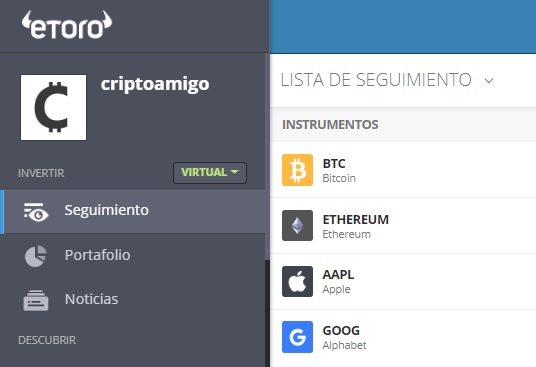
A virtual account can be a good way of gaining confidence before starting to trade with real funds. When you open your demo account, you will begin with a virtual balance of $ 100.000, to trade with a variety of financial instruments available on eToro, besides Ripple.
The first attempt is not usually that good. But don't worry, since you can ask eToro to deposit back the virtual $ 100k to your account.
Take into account that trading is mainly about being cold-minded, and perhaps using a demo portfolio can prevent you from controlling your impulses. It is not the same to operate with your own money than with fake funds, which you can lose without any consequences.
Finally, the demo mode is kind of pointless if you want to trade in the medium or long-term (with almost guaranteed returns only by replicating an index), since you would be wasting years to see the outcome. Demo accounts may be helpful for trying out before investing in the short or medium-term.