
Contents
eToro is an outstanding brokerage for acquiring Gram from South Africa
Pros:
- It's very easy to handle
- Allows to imitate investment strategies
- Allows short-trading
- Leverage is allowed
- Lets you make investments in countless of other products
Homepage: www.etoro.com/gram
You should certainly consider eToro if you are thinking about purchasing Gram from South Africa.
“Social trading”, a relatively new way of investing by replicating techniques and moves from other experienced investors, has become popular thanks to eToro.
If you are still a newbie or do not have much experience in investments, eToro is very useful. You can rest assured that you will be making a smart investment since the site emulates those from subjects with a long profit record. Additionally, in case you are an investor, the platform pays for your knowledge.
Another advantage is how easy the platform is, which turns out perfect for new users that are learning all about the trading world.
How do Contracts for Difference Work?
If you have entered eToro before, you probably realized that the acronym CFD appears over and over. We will explain exactly what this means, but you should know first that cryptocurrency trading on eToro is only CFD when you go short or leverage over x2 (but the platform does not even allow this option).
We will also explain concepts such as leverage and “going short”, in case you are considering day trading cryptocurrency or more advanced practices.
Even if you aren't “in the black”, you can still bet on eToro with CFDs. In a hypothetical case: you are sure that the Gram will go down, so you clearly think “if it is going to depreciate, I simply refrain from getting in and I'll go in when it has gone down”. Nevertheless, if it really falls, it might mean extra money for you.
You can accomplish that by “going short”. Basically, this is how it works:
- You ask someone for a loan of, let's say, 100 units of Gram, which cost $ 5,000 at the moment (these numbers aren't real)
- Next, you sell them at their current price, $ 5,000
- The price falls, as you calculated, and the unit of Gram goes from $ 50 to $ 30
- You purchase all 100 units once again, but at the current price, $ 3,000
- You return the 100 units
- You will have made $ 2000, since you keep the difference
Consider that it sounds much more tricky than it is: we can just say that by trading in Gram you can also make money if you predict it will go down.
What's the difference between CFDs and futures?
What are the differences between CFDs and Futures?
- Who is the counterparty? In the case of Futures, the counterparty is another investor. In CDFs, it’s the brokerage, in this case eToro
- When do they expire? Futures have a determined expiration. CFDs don’t expire
- Variety of options for trading The market for Futures is narrower. CFDs include a wide range of possibilities.
- Minimum investment Being higher figures, Futures require, proportionally, lower costs. Costs for CFDs are a bit higher, although not excessively.
- Use of leverage With Futures, it isn’t possible; while with CFDs it is.
If you still don't know what “leverage” is, we'll put it short: it is the possibility to use a higher amount than you actually have. That way, if you start with $ 100 and you use x2 leverage, you will be investing $ 200.
Leverage, Take Profit and Stop Loss
Assuming that, for example, you are positive that Gram is going up, and that you have $ 1,000 for “going long”, you should know that you can increase your investment and earn higher profits.
There's the possibility of requesting a credit at your bank, but you must know that all the process takes time, and when you receive the money, Gram might be already so expensive (if your guess was right) that trading wouldn't be convenient anymore.
Leverage is like a loan, but it is only a few clicks away! eToro allows you to invest (and earn) much more than what you have on the platform's wallet. You will simply see the different options as in the image below:
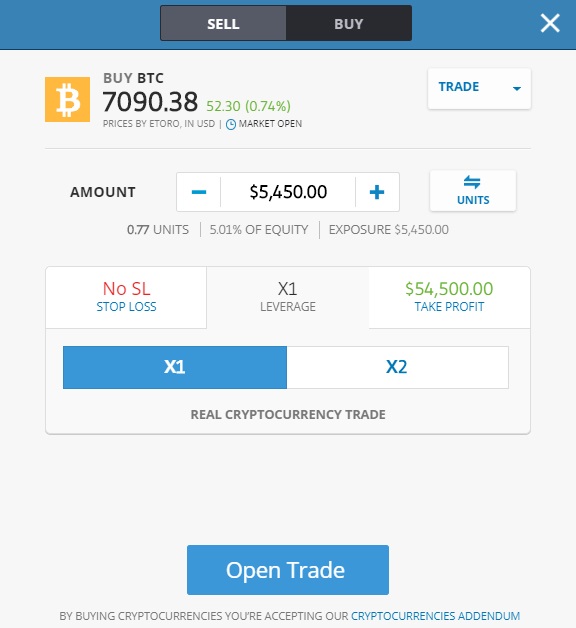
When trading with other assets you can use more leverage. The reason is that cryptocurrencies are usually medium-long term investments. However, leverage is used primarily for short-term operations or day trading. But let's explain how leverage works with the previous example:
- If you decide to invest $ 1,000 and you use leverage x2, you will be starting with $ 2,000 (remember that$ 1,000 was “borrowed” from eToro).
- Then, turns out that Gram does rises, as you assumed, and now the cost of your investment is $ 2,400 (20% more), so you decide to sell back.
- The $ 1k of leverage will be deducted, and you will have $ 1,400 left; which means you've earned $ 400, since the other $1,000 was yours initially.
By starting with $ 1000 and getting $ 400, you'll be earning 40% of your investment. That is pretty good.
But not everything is wonderful. If all goes as you intended and the price rises, you will make profits. Nevertheless, if the price goes down, you will also lose more money really fast.
Supposing that the asset didn't increase by 20%, but it decreased also by 20%, you won't lose $ 20 but $ 40, because of the leverage. Because of that, the terms “Take Profit” and “Stop Loss” are crucial when trading with leverage.
Take Profit is used as a form of reducing risks when trading. When you enter, you can set a profit limit and ask that your position is automatically closed when the asset reaches a price.
If you bought Gram at $ 100, you request eToro to close once it reaches $ 120. That way, you make sure you won't change your mind and decide to keep waiting in case it keeps going up, which could be a mistake.
Also, if you use leverage you absolutely need to place a Stop Loss order (take into account that any small loss is greater with leverage). You always need to establish a Stop Loss lower than that suggested by the platform.
About ETFs
What do you know about Exchange-traded funds? They are similar to index funds and are known for merging the benefits of stocks and mutual funds, because they can be exchanged at any moment in the market, but have much more investment possibilities and the fees are significantly lower.
Foreign exchange
Forex or currency trading is the exchange between two currencies in order to gain money through the operation.
If you want to exchange the EUR/USD pair, you acquire euros and pay with dollars, with the expectation that after buying the first currency (the euro) it will increase compared to the second (the dollar), to make a profit by selling it. Assume you entered when the price of one euro is 1.10 USD and you exit when the price has gone up to 1.15: that margin is yours once you sell again.
Perhaps you already inferred this, but operating with currencies usually implies investing a lot, because prices rarely increase that much, or using much leverage, which you know is a risk. Our recommendation for those starting in the world of trading is to choose another market to begin with, since Forex is risky and complex.
eToro allows trading with the most known currency pairs but keep in mind that this market works through CFDs, therefore the underlying asset won't be yours.
Shares
The most well-known financial assets are stocks or shares: these are fractions in which an enterprise that chooses to go public is divided, and you can be a shareholder of a company and obtain a profit, but you must know where to invest your money.
There are, essentially two kinds of stocks: those of companies that distribute their earnings among the shareholders and those that don't pay regularly. But that doesn't mean that those of the second type have less to offer. If a company does not pay every year but has a lot of potential, it is also worth investing in it, since the capital gain you will get from the sale of the shares can be much greater than what you would earn through dividends.
On eToro, if you invest in equities that distribute dividends, these will be reflected in your balance, and you can withdraw your money or reinvest it. We suggest, if you don't have financial urgencies, that you don't renounce the magic of compound interest and reinvest it in the company.
If you invest in stocks on eToro, you can use leverage to “dope” your trades. However, it is not advisable, since it would be a CFD and you would not receive dividends. Besides, as shares tend to be long-term investments, you will have to pay fees.
About ETFs
ETFs or Exchange-Traded Funds are a type of passively managed fund, similar to index funds. We can say that ETFs are somewhere between stocks and funds: they are publicly traded, that means they can be exchanged at any time at market price. Their advantage is that they are more diversified compared to stocks, and have lower fees.
Index Funds
This is the best option for people who can invest in the long term, especially for beginners, because it is less expensive, diversified, and the risk is lower.
Perhaps you have a different idea, but very few investors can beat the benchmark (although you have probably heard of managers who achieve huge returns).
But except for Warren Buffett and a couple more, not everything is as good as it sounds: when someone brags about having beaten the market, it was probably for a short time, or their rates are really high. In the end, indexing is better because commissions are minimal. Besides, past performances do not ensure a future one.
Index funds offer solutions for that: they usually beat active managers in the long term, and the fees are so much lower.
Commodity market
The main benefit of investing in raw materials is that prices are more stable than those of other assets. In fact, their security is what makes people often invest in raw materials, to take refuge from possible inflation or market volatility. Nonetheless, the cost of raw materials is determined by supply and demand, so if faced with the fear of inflation, demand rises a lot, so will the price.
Consider that the only intended income from the investment in raw materials will be the hypothetical capital gain after selling them: unlike stocks, these do not pay dividends.
Commodities are generally classified into hard raw materials, which include precious metals as gold, silver, or copper, as well as industrial metals, and oil; and soft raw materials, which are agricultural goods, like soy, cocoa, corn, or rice, for instance.
Trading strategies
When trading cryptocurrencies, there are different possible methods or strategies, such as day trading or buying and holding, for naming just a couple.
If you are just beginning in the world of trading, my recommendation is a middle point: when you open your Gram position, place a stop-loss order 15-20% below the maximum price, and let the rest happen on its own.
This means that if, for example, you buy a cryptocurrency at $ 10, it reaches $ 20, and after that it decreases to $ 12, your operation will be closed at $ 16-17 and you will obtain a pretty good profit.
You may be wondering: why not selling when the price is at its highest? But that would only work for a psychic or a fortune-teller. The mentioned strategy is more down-to-earth and can work out perfectly if it is well applied.
At some point, you can take your first steps with advanced investment techniques, like going short to profit from bear markets or using leverage.
How does eToro work?
We said before that eToro is very friendly and intuitive. Anyone can start investing without having to read endless explanations.
Everyone who has previously used Whatsapp, Pinterest or any of the most common social networks, has enough skills to use eToro.
Let's talk about the sign-up process and the different tabs you will find on the platform.
When you open your account, you will have to enter all the information that eToro asks for: first and last name, address…
Before you end up with the sign-up process, you will also have to answer some questions about your previous investment activities.
But don't worry: it's not about passing an exam. They only intend to know how much knowledge you have and what type of financial instruments they can suggest. For instance, if you have never invested before, they will not suggest that you invest in futures.
When you finish filling in all the requested information, the “incomplete profile” bar will disappear.
Let's see what the different sections of the page are.
“Set Price Alerts” allows you to set alarms on the price of certain assets. It is a very useful tool for when you want to buy an asset that is falling, but perhaps you think that it will decrease even more.
In the “News Feed” tab is the most social part of eToro: where users are interacting all day and sharing opinions, tips, and other valuable information.
In “Discover” you will find the tabs: “Instruments”, “People” and “CopyPortfolios”. And we already mentioned the kinds of assets that are available on eToro:
- Cryptocurrencies
- Exchange-Traded Funds
- Shares
- Commodities
- Currencies
- Index funds
The term “social trading” makes sense in the section “People”: that is where you can copy the strategies of any user you choose with just one click. You'll be able to see all their profiles and performances.
Through the search engine, you can find the users that you find more interesting: by risk level, types of financial instruments, average earnings… You just have to type the amount you want to invest and eToro will replicate the movements of the investor you selected, in proportion. “In proportion” means that if you put $ 1000 and the investor puts 10% of their capital in Amazon, eToro will invest $ 100 of your balance in the same asset.
In this part you will also see the three main types of CopyPortfolios, which are Top Trader, Market, and Partner.
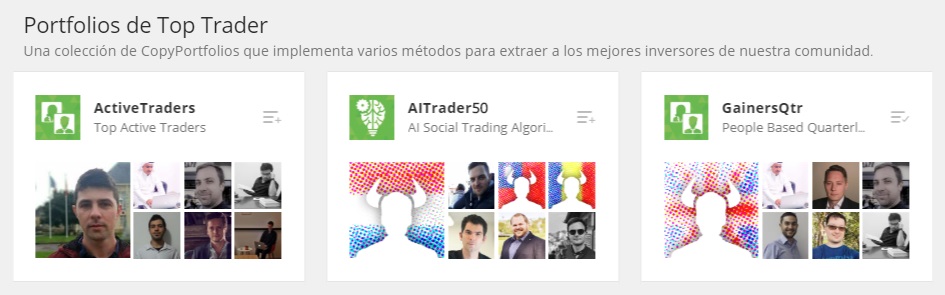
The benefit of copying to CopyPortfolios instead of people is that this way you will diversify the risk. The portfolios are identified so you can recognize them easily: one about gaming, another about large drone companies, another about pharmacy … Do you suspect that a certain sector is going to have success in the future? Then look, because surely there is a CopyPortfolio about it.